
Articles · Mesopotamia · Baghdad Battery
Battery or Spell Jar? Rereading the Baghdad Battery
The Baghdad Battery came out of the ground beside magic bowls, and its closest relatives at Seleucia and Ctesiphon were sealed tubes thought to hold written charms that their excavators could never confirm. Reading the excavation reports alongside every honest voltage measurement, this piece finds the jar differing from its siblings exactly where a cell would, and tests the open possibility that ritual specialists used a real electrochemical effect that never reached written science.
In 1996 a German conservation chemist set out to take the Baghdad Battery apart in print, and halfway through he described a better battery than the one in the jar.
Gerhard Eggert, a chemist who headed the conservation department of the Rheinisches Landesmuseum in Bonn, came down firmly against the battery in his article for Skeptical Inquirer [1]. But he noticed that most of the jar’s parallels were built differently. Their metal tubes were rolled bronze sheets with unsoldered seams, so any liquid would fill the whole pot, and the pots were porous earthenware. In that case, he wrote, “oxygen from outside could diffuse steadily into the electrolyte, which would be tantamount to a steady electrical current” [1]. In this reading, the famous jar became “a faulty deviation of the working Ctesiphon type” [1].
Then he stepped back from his own idea. “But I am not persuaded, even by my own speculation,” he added [1].
Thirty years later, a researcher who signs his paper from Westchester, New York, built a version of the jar in which the clay does much the same work. In January 2026 Alexander Bazes reported that tin solder on the outside of the copper tube, sitting in lye inside the porous jar, formed a second cell that he measured at over 1.1 volts [2]. Wired in series with the familiar copper and iron, the device was, he wrote, “capable of generating over 1.4 volts” [2]. His paper does not mention Eggert’s [2].
The volts are the part everyone repeats, and they may be the least revealing part of the story. The more telling detail is the company the jar kept. It was found with magic bowls [3]. Its nearest relatives came from digs that also turned up incantation bowls, and they have long been read as cases for written charms [4][5]. And the men who opened those relatives in the 1930s could not confirm what was inside them [4][5].
A Jar From a Mound Near Baghdad
The object is about the height of a coffee mug. König, who first reported it, described a vase-like jar of bright yellow clay with its neck removed. A cylinder of sheet copper with a closed bottom was stuck into the mouth with asphalt, and inside it was a completely oxidised iron rod, held in place by another stopper of asphalt [1].
The measurements depend on who held the ruler. In the translation Eggert quotes, König gave the jar as about 15 centimetres high and the tube as 26 millimetres across and 9 centimetres tall [1]. Paul Keyser, writing from the University of Alberta in a 1993 paper in the Journal of Near Eastern Studies, recorded an ovoid jar about 14 centimetres tall and 8 across, with a mouth of 3.3 centimetres, and a tube 9.8 centimetres long and 2.6 across [3]. Neither account explains the other, and we have kept them apart.
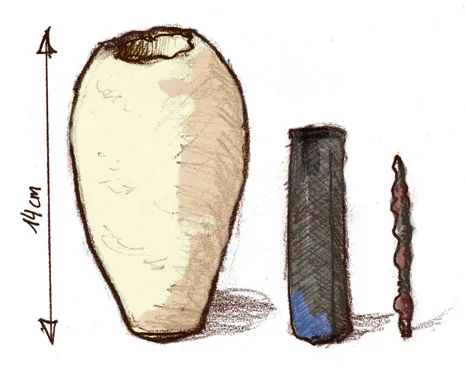
Keyser added details that matter later. The tube was rolled from copper sheet and soldered. Its bottom was a copper disc, sealed and covered with a layer of asphalt 3 millimetres thick. The iron rod, about 7.5 centimetres long, hung down the axis of the tube from the upper asphalt plug, and both copper and iron stuck up above that plug [3].
It came out of the ground in 1936 at a mound near Baghdad that the reports spell Khuyut Rabbou’a or Khujut Rabou’a, in what Eggert calls Parthian layers [1][3]. Keyser says members of the Iraq Antiquities Department found it in the course of regular excavations, in an undisturbed stratum of a Parthian settlement, “in association with magical bowls” [3]. He gave its date as the first century BC or the first century AD and favoured the later century [3]. For the find and its stratigraphy he cited König and a 1964 report by A. Al-Haik in the Iraqi journal Sumer, and for the date a 1978 exhibition catalogue [3]. We were not able to open any of the three.
Our record on the Baghdad battery asks the short version of the question: a battery, or just a jar. This piece goes back to the reports behind that question and finds that its two halves may not be opposites.
The Painter Who Saw a Cell
The man who first called it a battery was not trained as an archaeologist. Wilhelm König was an Austrian painter who, in the 1930s, served as director of the museum in Baghdad [1][3]. He announced the find in 1938 in the German journal Forschungen und Fortschritte [3]. “From its parts and their arrangement,” he wrote, “one might think that it must be a kind of ‘galvanic’ element or battery” [1].
Eggert suspected the shape did the persuading. A modern dry cell is a zinc cup with a carbon rod down its middle, and the jar resembles one in form, though not in its metals [1].
König had a second exhibit, and it was working in the bazaars around him. Baghdad’s silversmiths gilded objects with an electrical method, and König sketched it as a porous clay pot of gold solution standing in a salt bath with a zinc pole. He wondered whether it might be “older than one might think” [1]. Eggert traced the method to an invention by John Wright of Birmingham in 1839, which the Elkingtons included in their British patent 8,447. When König wrote, the supposedly ancient process was, in Eggert’s words, “only 99 years old” [1].
From there the claim took on a career of its own. In 1978 the Roemer- und Pelizaeus-Museum in Hildesheim, Germany, showed the find in an exhibition of objects from the Iraq Museum. Other venues called the object controversial; Hildesheim’s catalogue told visitors that “some 1,800 years before Galvani” the Parthians “knew an electrical cell” [1]. It staged a gilding experiment for journalists using an open model with no asphalt stopper, and German television had a restorer in a white coat pose as a chemist beside a replica [1]. In 2003 Bettina Schmitz of the same museum told the BBC, “There does not exist any written documentation of the experiments which took place here in 1978” [6].
The doubters had their excesses too. In 1960 C. MacKechnie Jarvis, writing “without the opportunity for visual examination of the find,” suggested it was a modern cell left in the desert by nineteenth-century telegraph enterprise [1].
Each side found in the jar what it was already looking for. That habit did not stop with the believers.
Half a Volt, Honestly Measured
The chemistry underneath is not in dispute. Put two different metals into a sour or salty solution, and a voltage appears between them simply because they differ [1]. The iron gives up electrons and the copper must take them in some reaction. Which reaction depends on the liquid, and nobody knows what liquid was used, if any [1].
So every replica is really a test of the liquid its builder chose. The first, built by W. F. M. Gray, used copper sulfate and, in an account by Ley that Eggert quotes, “worked quite well for a short time” [1]. Keyser built his own and measured carefully [3]. The readings below are the copper-and-iron figures in the sources we opened.
| Who | Liquid in the copper tube | Reading |
|---|---|---|
| Keyser, 1993 | salt solution, about 10% | fell to about 0.4 V within a minute |
| Keyser, 1993 | copper sulfate solution, 10% | about 0.45 V for several hours |
| Keyser, 1993 | fresh grapefruit juice; acetic acid at 25 to 50% | 0.49 V (±0.03 V), slow decline |
| Bazes, 2026 | salt water | about 0.26 V |
| Bazes, 2026 | lemon juice | about 0.35 V |
That is a quarter of a volt to half a volt. Keyser put the models built before his at about 0.5 volts and a few thousandths of an amp, and noted that a flashlight battery gives several hundred times the power [3]. The figures above one volt now attached to the jar come from one build only, in which a second cell is made by filling the clay jar with lye [2].
Eggert found a deeper problem in the original’s best feature. Because König’s tube was soldered and sealed with asphalt, no oxygen from the outside air could reach the liquid. Once the small amount dissolved inside was used up, “the current decreases to negligible levels” [1]. Natural organic acids and sour fruit juices, he added, citing Paszthory and the chemist W. Jansen and colleagues, are too weak to release hydrogen at the copper; that would take strong mineral acids unknown at the time [1].
Then there is electroplating, König’s favourite guess. Keyser ruled it out for a chemical reason, not an electrical one. A plating bath needs the metal to be deposited already dissolved in the liquid. Silver dissolves in nitric acid and gold only in aqua regia, and those mineral acids were not isolated before about AD 1300 [3]. Gilding in this period was done instead by mercury amalgamation, a paste of gold and mercury heated until the mercury drove off [3].
Keyser also put a figure on it: at one milliamp, he wrote in a footnote, plating a single gram of silver would take about 1.1 days [3]. The arithmetic does not come out that way. By Faraday’s law, which ties a flow of charge to the mass of metal it deposits, one milliamp lays down about 4 milligrams of silver an hour, so a gram takes about ten days [7][8]. Keyser’s figure fits a current about ten times larger. That correction is our own calculation, and the working is in our notes. It does not rescue the plating idea. It only puts the obstacle back where Keyser put it, in the missing gold and silver solutions.
The objects that would settle the matter have never turned up. Eggert found no ancient object supporting electroplating or electrical medicine, no written evidence of either, and no Near Eastern object that laboratory study had shown to be electrogilded [1]. “It’s a pity we have not found any wires,” the British Museum metallurgist Paul Craddock told the BBC in 2003 [6].
The Siblings at Seleucia and Ctesiphon
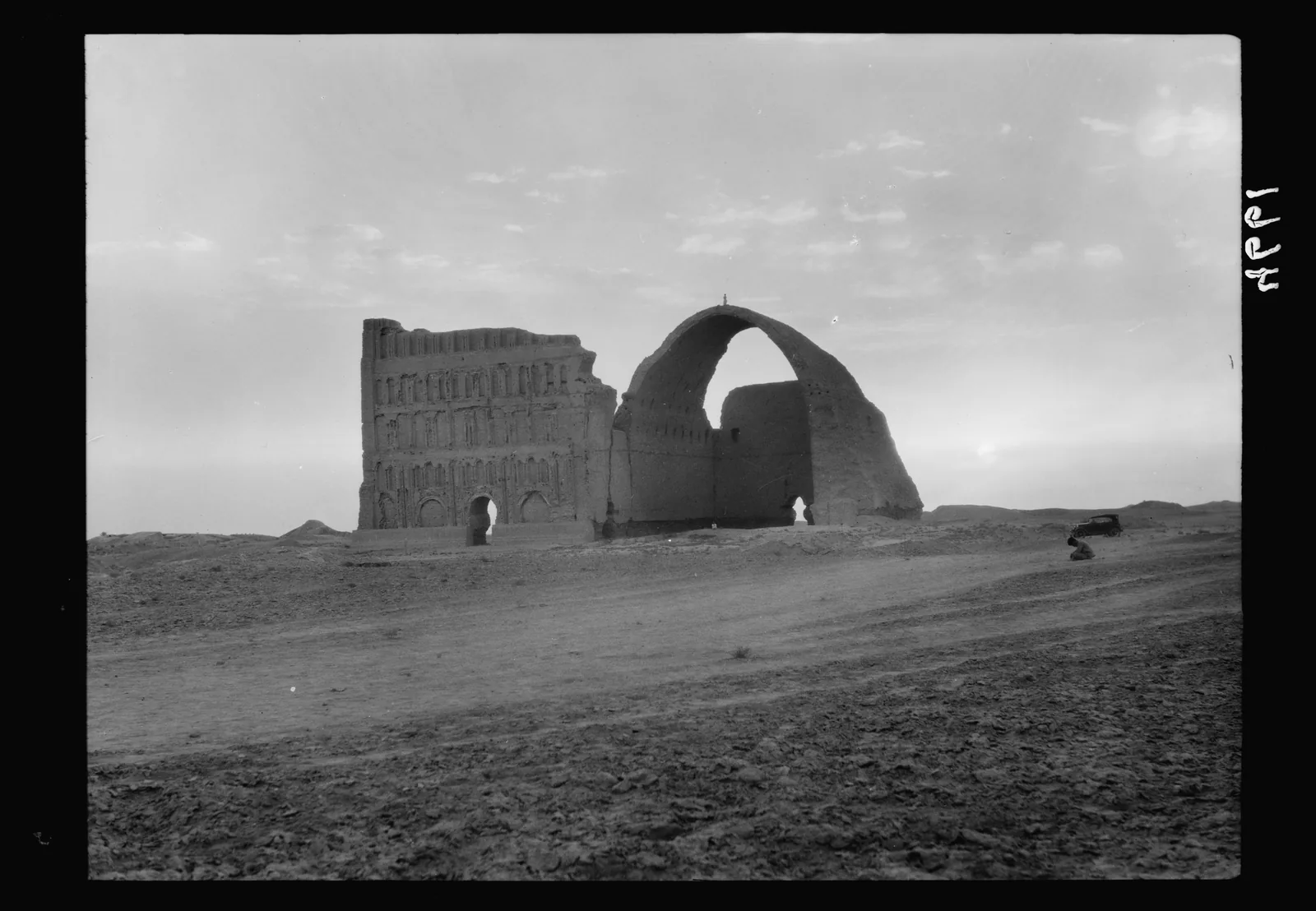
The other explanation, the one most archaeologists prefer, begins at Seleucia on the Tigris, beside the Parthian and Sasanian capital of Ctesiphon, about 35 kilometres south of where Baghdad now stands [9]. In his report on the 1930 season of the University of Michigan excavations at Tel Umar, Leroy Waterman described four small sealed jars found in the closing days of the dig [4].
The report is plain and careful. The jars were six to eight inches high, of “very common unglazed ware,” and all were sealed with bitumen stoppers [4]. One stood upright and held fragments of a small glass bottle. The other three lay on their sides, each held in place by small rods set upright at its ends and sides. Each jar had one iron rod; the rest were bronze [4].
Inside each of the three lay a small bronze cylinder, originally sealed at both ends, about an inch and a quarter across and three inches long [4]. Each had held what looked like a tightly wrapped roll. A preliminary look under the microscope showed plant fibre, not animal, “hence probably papyrus.” Waterman closed the paragraph with a promise: “there is presumptive evidence of writing, which will be verified as soon as practicable” [4].
That verification is not in the report, and we did not find it in any source we opened.
Waterman did record the setting. The jars lay scattered around an isolated mud-brick building that showed “every indication that it is later than the first Parthian level.” None was connected with a burial. Three incantation bowls lay nearby. Two were of the usual Aramaic kind, “covered with the simulation of writing,” and the third was inscribed in Syriac. A small cloth bag close by held coins, “the silver exemplars being definitely Sassanian” [4].
In the winter of 1931/32 a joint expedition of the Berlin State Museums and the Metropolitan Museum of Art worked at Ctesiphon itself, and Ernst Kühnel wrote up the results. Some of the plain pots and jugs, he reported, held cylindrical capsules of sheet bronze glued along the side, which “perhaps” contained incantations or blessings written on papyrus (our translation) [5]. Then came the sentence that tends to drop out of retellings: the decayed, powdery mass inside allowed no conclusion about the original material “even after careful chemical analysis” (our translation) [5]. Even the metal shifted between languages. The German text says bronze; the English summary in the same report says copper cases holding magic formulas “written probably on papyrus” [5].
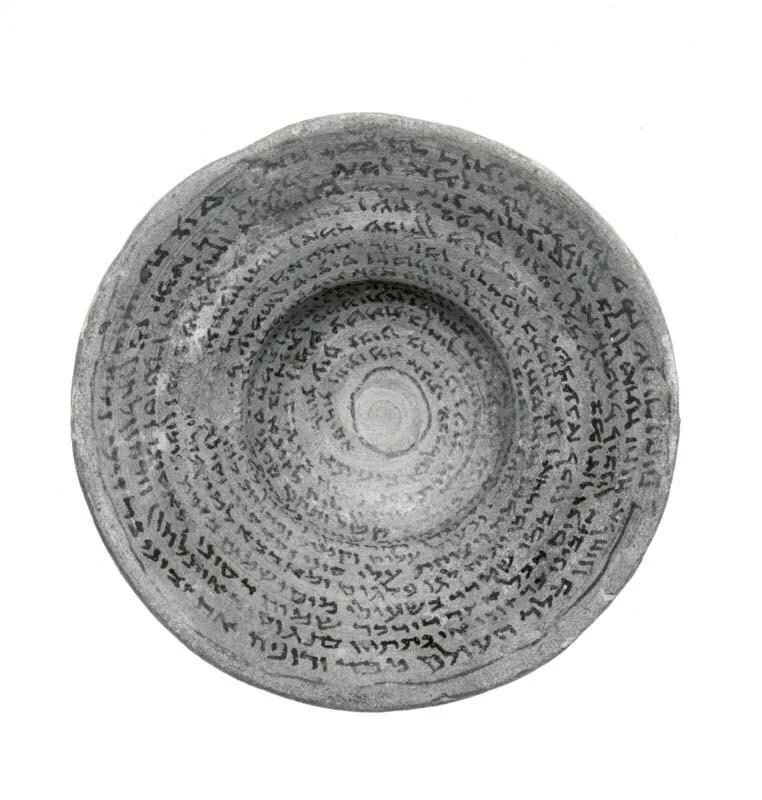
Magic bowls turned up there too, inscribed in Hebrew, Mandaic and Pahlavi and, in 1933, not yet read [5]. The report’s caption places one of the capsule jugs in New York [5].
This is the strongest case against the battery, and it deserves full strength. E. Paszthory, in a 1989 study Eggert summarises, read these objects through the magical meaning of metals and took them as containers for blessings or incantations on organic material, as most of the excavators had half a century before. Eggert called that “much more probable” than a power source [1]. The asphalt settles nothing either way. Keyser notes that bitumen was the normal Mesopotamian seal [3], and Kühnel found large storage jars at Ctesiphon lined inside with it [5]. A jar sealed with asphalt is, first of all, a jar.
But the jar from Khujut Rabou’a differs from its siblings at exactly the points where a cell would differ. At Tel Umar the iron stood outside the jar, as one of the rods pinning it in place [4]. In the Baghdad jar the iron hangs inside the copper, kept off the floor by asphalt that, in Keyser’s reading, would prevent a short circuit [3]. The sibling tubes were sealed at both ends or glued along a seam [4][5]; this one was soldered into a watertight cup [3]. König took the others as parallels, Keyser wrote, “but the absence of the internal iron electrode elicits hesitation” [3].
Keyser, for his part, rounded the scroll evidence up. He describes the Seleucia tubes as “stuffed with papyrus,” calls the rods “needles,” and places them in “what appeared to be a magician’s house” [3]. Waterman, who reported the dig, wrote “probably papyrus,” described rods holding the jars in place, and called the building a “peculiar rectangular structure” [4]. Of the Baghdad jar Keyser wrote, “It is indeed difficult to see what else the device could be” [3].
Parthian or Sasanian
The jar’s date is a second dispute inside the first. The Parthian era at Ctesiphon ended in 224 CE with the defeat of Artabanus IV [9], and the Sasanian dynasty that followed ruled from 224 to 650 [10]. König called his find Parthian, and Keyser’s date rests on the stratigraphy reported by Al-Haik [1][3].
Not everyone accepts it. “Although this collection of objects is usually dated as Parthian, the grounds for this are unclear,” St John Simpson of the British Museum’s Near East department told the BBC in 2003. “The pot itself is Sassanian” [6].
The siblings lean his way. Waterman’s jars lay near Sasanian silver coins around a building later than the first Parthian level [4]. Kühnel described his capsule jugs among the Sasanian ceramics of Ctesiphon [5]. No laboratory date for the Baghdad jar appears in any source we found. Keyser knew of no attempt at thermoluminescence dating of the clay, a method that measures when a pot was last fired, and thought radiocarbon dating of the iron might be possible [3].
If Simpson is right, less changes than it first seems, and in a direction few have noticed. A Sasanian date would put the jar in the same world as its siblings, the world of the incantation bowls around Seleucia and Ctesiphon. It would stop being an orphan from an earlier age and become one variant within a living practice of sealed metal tubes in jars. The puzzle would get sharper: why did one maker in that practice hang iron inside a watertight copper sleeve when others put in a roll?
If Keyser is right instead, the Baghdad jar is the oldest of the group, and the later tubes without iron need explaining. Keyser had a suggestion. The liquid would eat the iron within a few weeks, so “perhaps they were only emplaced during actual use” [3]. Either way, the iron-in-copper jar sits in a magical setting [3].
A Second Cell in the Clay
Bazes began with the jar’s oddities. Why choose an unglazed, porous pot to hold the copper tube? Why solder a tube that would sit in liquid, when solder and copper together corrode? He took those features as design rather than accident [2].
His tests are simple and clearly described. A pin of pure copper standing in a clay pot of potassium hydroxide solution gave about 0.43 volts. A single drop of 60/40 tin-lead solder on the pin pushed it past one volt. Pure tin gave 1.04 volts, pure lead 0.7, an iron rod 0.62 [2]. When the assembled device was wired to a copper plate in a salt water bath, bubbles formed on the plate almost at once, and by morning its surface had been etched while a control plate beside it was unaffected [2].
The caveats are just as clear. Sino-Platonic Papers, the University of Pennsylvania series that published him, describes itself as a home for research that, “because of its unconventional or controversial nature, might otherwise go unpublished,” and says submissions are regularly sent out for peer review [2]. The outer cell needs lye in the jar, and his test solution was 25 percent potassium hydroxide [2]. He states that lye “would have been a commonplace material in any historical period” [2], but the paper does not test a lye an ancient maker could have made. It also describes the solder as tin and lead [2], while no analysis of the original’s solder appears in any source we opened; Keyser listed the solder among the metals still to be tested [3].
Bazes is candid about his method. Writing on the linguistics blog Language Log in January 2026, he said he had set out to ask the “doubly biased question” of how he could read the artifact “as having been a good battery for c.100-300 CE,” and then answered himself: “Biases? Confirmed!” [11]. He is not sure of his own mechanism either. “Whether or not oxygen from the air forms part of the equation (my theory),” he wrote, the materials will corrode badly [11]. Oxygen seeping through porous clay is the very mechanism Eggert floated in 1996, in the paper Bazes does not cite.
A Spell That Corrodes
Here the evidence runs out and interpretation begins. This section is speculation, drawn from three specialists who reached for the same idea separately, and then from us.
In 1993 Keyser proposed that the cells were used to dull pain. His model was the Roman physician Scribonius Largus, who around AD 47 to 48 recommended putting a live torpedo fish, an electric ray, under the feet of a gout sufferer standing in the surf [3]. He conceded that this “must remain hypothetical until further confirming evidence is forthcoming” [3]. More important is where he placed the device. The Mesopotamian healer called the asū, he noted, was associated with magicians, and “the devices were found in magical contexts” [3]. His closing sentence predicted that the device “became merely a conjurors’ trick and gradually faded from view, just as the magicians of Mesopotamia did” [3].
In 2003 Craddock, the British Museum metallurgist, put it more briefly: “I have always suspected you would get tricks done in the temple” [6].
In 2026 Bazes went further. On Language Log he credited a video lecture by the Penn Museum archaeologist Brad Hafford for pointing him to a ritual role [11]. Then he suggested that the battery’s purpose “may have been solely to corrode the iron rod inside the copper vessel and the solder seams on its outside” [11]. A written prayer wrapped around the rod would give its author “visual evidence of an energetic influence” passing through it [11].
Set those three beside the excavation reports and the old either-or starts to look like a false choice. Our reading, and it is only that: around Seleucia and Ctesiphon, ritual specialists used sealed metal tubes in jars. Some held rolls, probably of papyrus. At least one held iron inside copper, with a liquid that would make metal tingle, fizz or eat itself away. Keyser thought no ancient theory of matter could have predicted that effect, and guessed at an accidental discovery: someone stirring vinegar in an iron bowl with a bronze spoon would feel a tingle in the hand or lip [3]. Knowledge found that way would live in hands, not in books, and could pass from teacher to apprentice and end with the last of them. Keyser gave a version of that reason in 1993: the devices “were associated with magicians and so never entered Greco-Roman science” [3].
The mainstream answer is strong and deserves its full weight here. “Successful experiments alone can show only a supposed ancient technique to be possible, but never its application,” Eggert wrote [1]. Thor Heyerdahl’s voyage in Ra showed that an Egyptian-style boat could cross the Atlantic; accepting that Egyptians did so would need archaeological evidence from America [1]. No wire, no plated object and no text has been tied to these jars [1][6]. And Eggert’s summary of the replica work remains hard to beat: “With the help of additional assumptions, one can get some current some of the time from the object” [1].
What Would Settle It
The tests are known, and none needs a new excavation. Keyser listed them in 1993: thermoluminescence on the clay, radiocarbon on the iron, and X-ray fluorescence tests of the copper, iron and solder for the trace impurities that might fix a date [3].
Two more follow from the documents, and these suggestions are ours. If Bazes’s outer cell ever ran, the outside of the copper tube should show the kind of solder corrosion his replica showed after heavy use [2], and the clay should hold residues of whatever caustic liquid sat in it. If the tube was a charm case, its inside might hold organic traces like the powder Kühnel’s team could not identify [5]. And if the rolls from Tel Umar were ever shown to carry writing, as Waterman promised in 1931, the scroll-case reading would gain the evidence it has always assumed [4].
Where the jar is today, we could not establish from any source we opened.
What remains is the object as Keyser described it. A copper tube is sealed into a clay jar with asphalt. An iron rod hangs down its axis. At the top, copper and iron both stick up above the plug, side by side, two bare ends with nothing attached [3]. If anything was ever connected to them, it has not been found.
Sources
- Eggert, Gerhard. "The Enigmatic 'Battery of Baghdad'." Skeptical Inquirer 20, no. 3 (May/June 1996): 31–34. Includes König's description in Dubpernell's English translation. https://cdn.centerforinquiry.org/wp-content/uploads/sites/29/1996/05/22165042/p31.pdf
- Bazes, Alexander. "The Baghdad Battery: Experimental Verification of a 2,000-Year-Old Device Capable of Driving Visible and Useful Electrochemical Reactions at over 1.4 Volts." Sino-Platonic Papers 377 (January 2026). https://sino-platonic.org/complete/spp377_baghdad_battery.pdf
- Keyser, Paul T. "The Purpose of the Parthian Galvanic Cells: A First-Century A.D. Electric Battery Used for Analgesia." Journal of Near Eastern Studies 52, no. 2 (1993): 81–98. DOI: 10.1086/373610.
- Waterman, Leroy, ed. Preliminary Report upon the Excavations at Tel Umar, Iraq. Ann Arbor: University of Michigan Press, 1931, pp. 61–62. https://repo.library.stonybrook.edu/xmlui/handle/11401/88657
- Kühnel, Ernst. Die Ausgrabungen der zweiten Ktesiphon-Expedition (Winter 1931/32): Vorläufiger Bericht. Berlin: Staatliche Museen; New York: Metropolitan Museum of Art, 1933, German text and English summary, Abb. 45. Quotations from the German are our translation. https://repo.library.stonybrook.edu/xmlui/handle/11401/89072
- Frood, Arran. "Riddle of 'Baghdad's batteries'." BBC News, 27 February 2003. Used only for quoted remarks by St John Simpson, Paul Craddock and Bettina Schmitz. http://news.bbc.co.uk/2/hi/science/nature/2804257.stm
- NIST, CODATA value of the Faraday constant. https://physics.nist.gov/cgi-bin/cuu/Value?f
- Commission on Isotopic Abundances and Atomic Weights (CIAAW), standard atomic weight of silver. https://www.ciaaw.org/silver.htm
- Encyclopaedia Iranica, "Ctesiphon." https://www.iranicaonline.org/articles/ctesiphon
- Encyclopaedia Iranica, "Sasanian Dynasty." https://www.iranicaonline.org/articles/sasanian-dynasty
- Bazes, Alexander. "Battery-Powered Prayers." Guest post, Language Log, 8 January 2026. https://languagelog.ldc.upenn.edu/nll/?p=72543
Not opened, and cited only through the sources above: W. König, "Ein galvanisches Element aus der Partherzeit?", Forschungen und Fortschritte 14 (1938); A. Al-Haik, "The Rabbou'a Galvanic Cell," Sumer 20 (1964); E. Paszthory, MASCA 6 (1989); W. Jansen et al. (1987, 1993); the 1978 Hildesheim exhibition catalogue.
Our calculation (footnotes [7], [8]): 1 g of silver needs 894.47 coulombs (Faraday constant 96,485.332 C/mol, silver 107.8682 g/mol, one electron per atom); at 1 mA that is 894,474 seconds, about 10.4 days, or about 4.0 mg of silver per hour. Keyser's 1.1 days corresponds to about 9.4 mA.
Images are a 1932 photograph by the Matson Photo Service (public domain), a drawing by Ironie (CC BY-SA 2.5), and a photograph from The Metropolitan Museum of Art (CC0), credited and licensed in each caption; none is AI-generated, and no labels or overlays were added. The video is included for viewing and is not cited as a source.