Articles · Mali · Dogon
What the 1950 Dogon Paper Really Says About Sirius
Griaule and Dieterlen’s 1950 paper is a composite of four Dogon informants. It describes a white, tiny, very heavy companion of Sirius on a fifty-year orbit, “counted double” as a ritual hundred, plus a second companion that has a satellite of its own. The authors say they never asked how the Dogon knew this, but their own footnote cites Paul Baize’s 1931 review. That review contains every headline property, including a reported “Sirius-C” that later work explains as a background star. The match breaks in places: the paper has Sirius “seen as red”, gives the companion a yearly spin, and makes its third body larger. Van Beek’s restudy could not find the system and traced what remained to Griaule. Ridpath found no record of missionaries discussing Sirius. Under the star sits Dieu d’eau’s starless 1946 account of the Nommo as twin water beings who carried speech and kept the sky-forge. Van Beek still found them feared at every pool around Tireli. No source opened here traces where that layer came from.
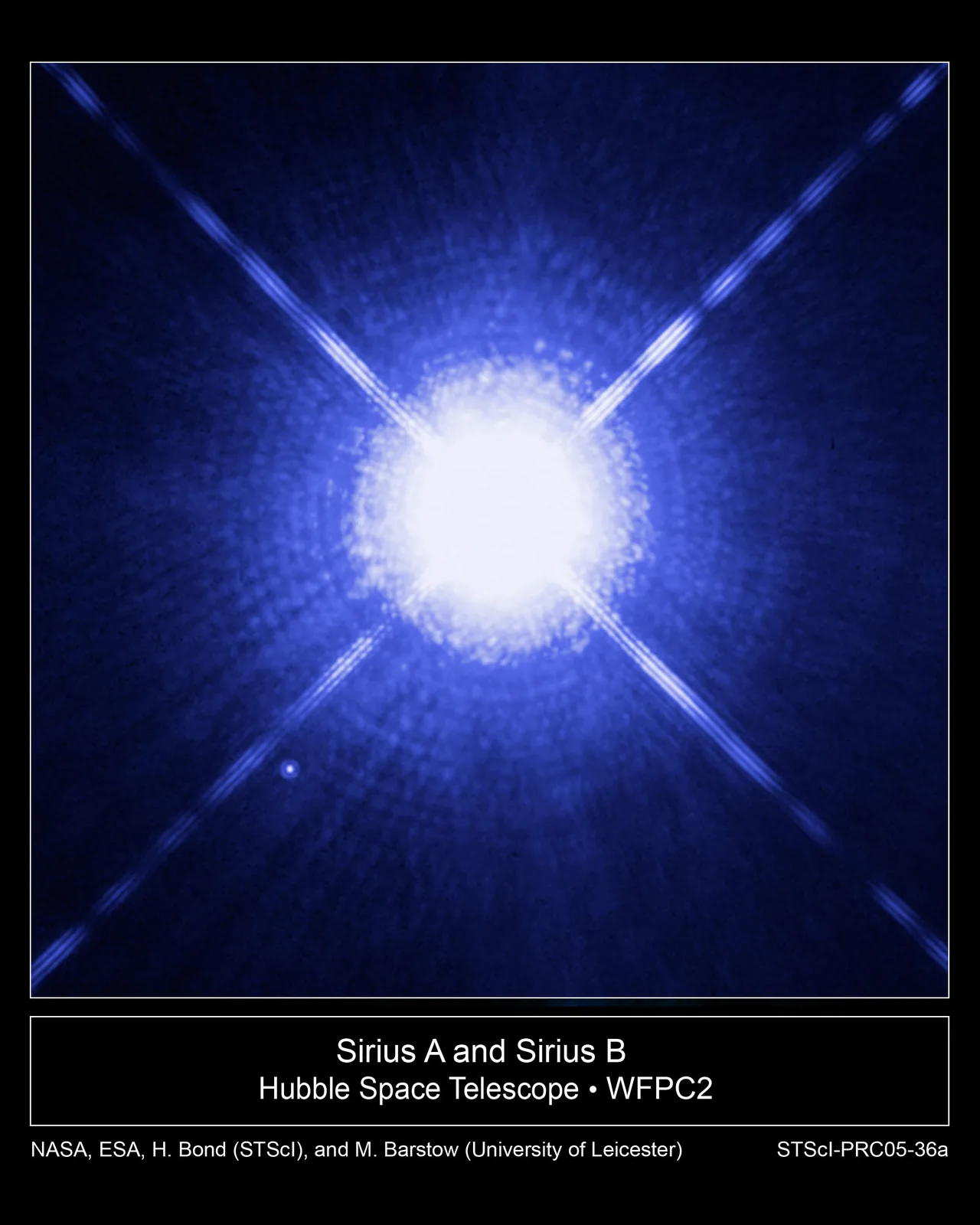
In 1950, two French ethnologists reported that Dogon initiates in Mali described a companion of Sirius as the smallest thing in existence and the heaviest star [1]. According to the paper, it was white, it circled Sirius in fifty years, and it was made of a metal a little brighter than iron [1]. In the same paper, the ethnologists said they had not asked how anyone could know this.
“The question of how men with no instruments know the movements and certain characteristics of practically invisible stars has not been settled, nor even asked,” wrote Marcel Griaule and Germaine Dieterlen (our translation from the French) [1].
Eight pages later, a footnote does what the authors said they would not do. It compares the fifty years with the orbit of the real companion of Sirius, and it names an astronomy article from 1931 [1].
That article is free to read today. So is the 1950 paper, and so is the 1948 book in which Griaule set down the Dogon creation story as one blind elder told it. We read all three in the original French, along with the field study that tested them forty years on. Each says something different, and the differences are where this story lives.
Twenty-Two Pages From Bandiagara
The paper is “Un système soudanais de Sirius”, printed in the Journal de la Société des Africanistes, volume 20, pages 273 to 294 [1]. It says the knowledge was found among four peoples of the French Sudan, today Mali: the Dogon of the Bandiagara district, the Bambara and Bozo of the Ségou district, and the Minianka of Koutiala [1]. The Minianka never get a section of their own.
The central inquiry ran among the Dogon from 1946 to 1950 [1]. The authors name four principal informants. Innekouzou Dolo was a woman of 65 to 70, a priestess of Amma and a diviner. Ongnonlou Dolo, 60 to 65, was the patriarch of the village of Go. Yébéné, 50, and Manda, 45, were priests of the Binou cult [1]. Ongnonlou, the paper says, set out the whole system; the others gave its essential parts [1].
Their accounts were then “melted into a single exposition” (our translation) [1]. The reader of 1950 never hears one Dogon voice. The paper is a composite, and it says so.
It also carries a warning that is easy to miss. What Ongnonlou knew, the authors write, was only a “light knowledge”, a Bambara expression for the first stage of a secret teaching. Its rules were “simplified in some parts and complicated in others to divert attention from calculations much more secret still” (our translation) [1]. And they state that the material “gave rise, on our part, to no hypothesis or search for origins” (our translation) [1]. Hold on to that sentence.
Our record on the Dogon and Sirius covers the public argument that grew up around this paper. This piece stays inside the documents.
What the Paper Actually Says
Sirius, the paper reports, is called sigi tolo, “star of the Sigui”, or yasigi tolo [1]. “Sirius is not the base of the system,” the authors write (our translation) [1]. The star that holds the initiates’ attention is a tiny one they call pô tolo. Pô is fonio, a small West African grain whose botanical name is Digitaria exilis, and the authors call the star Digitaria throughout [1].
Here is what the paper attributes to Digitaria, in its own order.
Its orbit around Sirius stands perpendicular to the horizon [1]. When it is close to Sirius, Sirius grows brighter; when it is farthest away, it twinkles so much that an observer thinks he sees several stars [1]. It turns on itself once a year [1].
“The period of the orbit is counted double, that is, one hundred years,” the paper says, because the Sigui ceremonies are grouped in pairs of “twins” (our translation) [1]. A footnote adds that in the Dogon base-80 count a hundred is “eighty and twenty” [1]. So the famous fifty years appears in the paper as half of a ritual hundred.
“The star, which is white in colour whereas Sirius is seen as red, is at the origin of things” (our translation) [1]. The word for white is there on page 284. So is the word for red, which matters later.
“Digitaria is the smallest of all things. It is the heaviest star,” the informants say (our translation) [1]. It is made of a metal called sagala, “a little brighter than iron”, so heavy that “all earthly beings together cannot lift it” (our translations) [1]. It weighs as much as 480 donkey loads, which the authors convert to about 35,000 kilograms, and yet “in theory” it is the size of a spread ox hide or a mortar [1]. The 480 is not a measurement. The paper explains it as 80 multiplied by 6, used “as the symbol of the greatest of numbers” [1].
Then comes a second companion. A star called emme ya, “Female Sorghum”, is “larger than it, four times lighter”, and travels a wider path in the same direction and the same fifty years (our translation) [1]. It has a satellite of its own, the “star of Women” [1]. The Sirius of this paper has two companions, and one of them has a satellite.
The figures that record all this were drawn in millet porridge above shrine doors and in red ochre on a rock face at Yougo [1]. Others were painted on the façade of the Hogon of Arou’s house, or traced at the house entrance by the oldest woman of a family [1]. One oval, in millet porridge inside the Hogon of Arou’s house, is about a metre long [1]. Nowhere does the paper use the word for sand. The label “sand drawing” belongs to an English caption: Ian Ridpath’s, in 1978, under a diagram he redrew from the paper [7].
The authors also flag their own problem. The orbit that governs the Sigui takes fifty years, yet two Sigui are sixty years apart. “There is a contradiction here that has not yet been resolved,” they write (our translation) [1]. They wonder whether the date is brought forward each time, so that outsiders go on believing the official period is sixty years [1].
The Ceremony That Keeps Its Own Archive
The Sigui is the hinge of the whole system. The paper says the Dogon hold it every sixty years to renew the world [1]. The sixty itself carries a footnote: “a figure accepted by ourselves in 1931, and which may be kept provisionally” (our translation) [1]. The interval that frames the whole paper was adopted by the authors themselves, fifteen years before the central inquiry began.
The popular belief, the paper says, is that a fault in the rock at Yougo Dogorou glows red in the year before the ceremony [1]. Long gourds that nobody planted are said to spring up outside the village [1]. The elders of Yougo keep a plainer count: thirty beer feasts, one every two years, each marked with a cowrie shell [1].
The ceremony also leaves objects behind. At each Sigui a great wooden mask is carved and laid in a rock shelter beside the masks of earlier ceremonies [1]. The authors call these masks “in a way, the archives of the villages” (our translation) [1]. Series of three or four are common, which on a sixty-year cycle reach back to about 1780 and 1720 [1]. At Ibi, nine could still be counted in 1931, with traces of three older ones in the dust behind them [1]. On the same sixty-year reckoning, the authors date the oldest of the nine to the start of the fifteenth century, and the traces to the first half of the thirteenth [1].
A second series is woven, not carved. For each Sigui the regional chiefs, the Hogon, have a fermentation support plaited from baobab fibre for the first ritual beer [1]. Counting fourteen of these for Sanga, again at sixty years apiece, the paper reaches the twelfth century [1]. Every one of those dates leans on the sixty-year interval that the authors themselves called provisional.
Inside this calendar sits a story about how the count began. Before the discovery of Digitaria, the paper says, the supreme chief was sacrificed at the end of his seventh year [1]. His spiritual principles were sent to the star, which was known to exist but stayed invisible [1]. The eighth chief, having discovered it, faked his own death with his son’s help, reappeared some months later, and told his successor that he “had gone into Digitaria” and knew its secrets [1]. From then on, each chief would reign sixty years. Restored to office, “he made the sky rise, which until then had been so close to the earth that one could touch it” (our translation) [1]. The authors add, fairly, that the belief in a once-low sky is held by many other peoples too [1].
Footnote 1, Page 282
Now the footnote. It reads: “The 50-year period is very close to that of the companion of Sirius. Cf. P. Baize, Le Compagnon de Sirius, l’Astronomie, Sept. 1931, p. 385” (our translation) [1].
Paul Baize’s article, “Le compagnon de Sirius”, runs from page 383 to page 397 of volume 45 of L’Astronomie, the bulletin of the French Astronomical Society [2]. The NASA Astrophysics Data System has a free scan. It is a careful review of everything known about the companion in 1931, and reading it next to the 1950 paper is an odd experience.
On page 385, Baize writes that the companion’s period “appears very close to 50 years” (our translation) [2]. On page 392 he reports that Walter Adams at Mount Wilson took its spectrum and found “not a red star but a white or yellowish-white star” (our translation) [2]. On pages 392 and 393 he describes Arthur Eddington’s hypothesis of a “white dwarf, of small volume but extremely high density” (our translation) [2]. On page 394 he gives its radius as about 20,000 kilometres, barely more than three times Earth’s, and its density as about 57,000 times that of water [2]. On page 396 he repeats Eddington’s image: a ton of the companion’s matter could fit in a matchbox [2].
Small, white, extraordinarily heavy, fifty years. Every one of those words was in the article the 1950 authors cited.
Then, on page 389, comes a section headed “Sirius, étoile triple ?”, “Sirius, a triple star?” [2]. On 4 February 1926, Baize reports, the astronomers Innes and van den Bos at the Union Observatory in Johannesburg saw “a minuscule star of the twelfth magnitude” beside the companion [2]. It was seen again in 1928 and 1929, and Baize calls it Sirius-C [2]. Baize was cautious: “further confirming observations must be awaited before admitting the existence of a third star in the system of Sirius” (our translation) [2].
In 2000, Jean-Marc Bonnet-Bidaud and colleagues searched the sky around Sirius for any further companion with a coronagraph, an instrument that blocks out a bright star’s glare. They concluded that the 1920s object was “most probably an unrelated” background star, which passed closest to Sirius in October 1937 [4]. Modern astrometry, the measurement of stars’ positions, rules out further companions of Sirius down to about 15 to 25 times the mass of Jupiter, for most orbits [3].
| Property | 1950 paper (Dogon informants) [1] | Baize, 1931 [2] | Today [3][4] |
|---|---|---|---|
| Orbit | 50 years, “counted double” as 100 | “very close to 50 years” | 50.13 years |
| Colour of companion | white | white by spectrum; seen as “copper red” by van den Bos in 1927 | white dwarf |
| Colour of Sirius | “seen as red” | “dazzling bluish-white” | an A-type star, blue-white |
| Size | smallest of all things | radius ≈ 20,000 km | a little smaller than Earth |
| Weight | heaviest star; 480 donkey loads | 57,000 times water; a ton in a matchbox | about the mass of the Sun |
| A third body | emme ya, larger, four times lighter, same 50 years | “Sirius-C”, a tiny 12th-magnitude star near the companion | none; the 1920s object was a background star |
Where the Match Breaks
Read the table across and the match is strong but not clean.
Baize’s third star was tiny and clung close to the companion, with an orbit he guessed at eighteen months to two years [2]. The paper’s emme ya is larger than Digitaria and shares its fifty-year path round Sirius [1]. Read literally, emme ya at a quarter of Sirius B’s mass would weigh more than 250 Jupiters by our own arithmetic. That is over ten times the limit modern astrometry can rule out [3]. The idea of a third body is in Baize. The details are not.
The yearly rotation, the orbit perpendicular to the horizon, and the twinkling at greatest distance are not in Baize either [1][2]. Nor is the metal sagala.
The colours are the strangest part. Baize reports that van den Bos in 1927 saw the companion as “copper red”, in sharp contrast with “the dazzling bluish-white brilliance of Sirius” (our translation) [2]. The 1950 paper has the companion white and Sirius “seen as red” [1]. On the companion it agrees with the spectroscope. On Sirius it reverses what Baize’s astronomers reported.
Nobody we read explains that line. Bonnet-Bidaud and colleagues, in the same 2000 paper, note a separate hypothesis that Greek and Chinese records point to Sirius looking redder some centuries before the common era [4]. That is their hypothesis about the star, not about the Dogon. Whether the Dogon line has anything to do with it is an open question that nobody has tested.
Forty Years Later, Nine Kilometres From Sanga
The strongest test came from the field. The Dutch anthropologist Walter van Beek made a first reconnaissance in January 1978, did fieldwork from April 1979 to July 1980, and returned eight times over the following decade [5]. His village, Tireli, lies nine kilometres from Sanga, where Griaule worked [5].
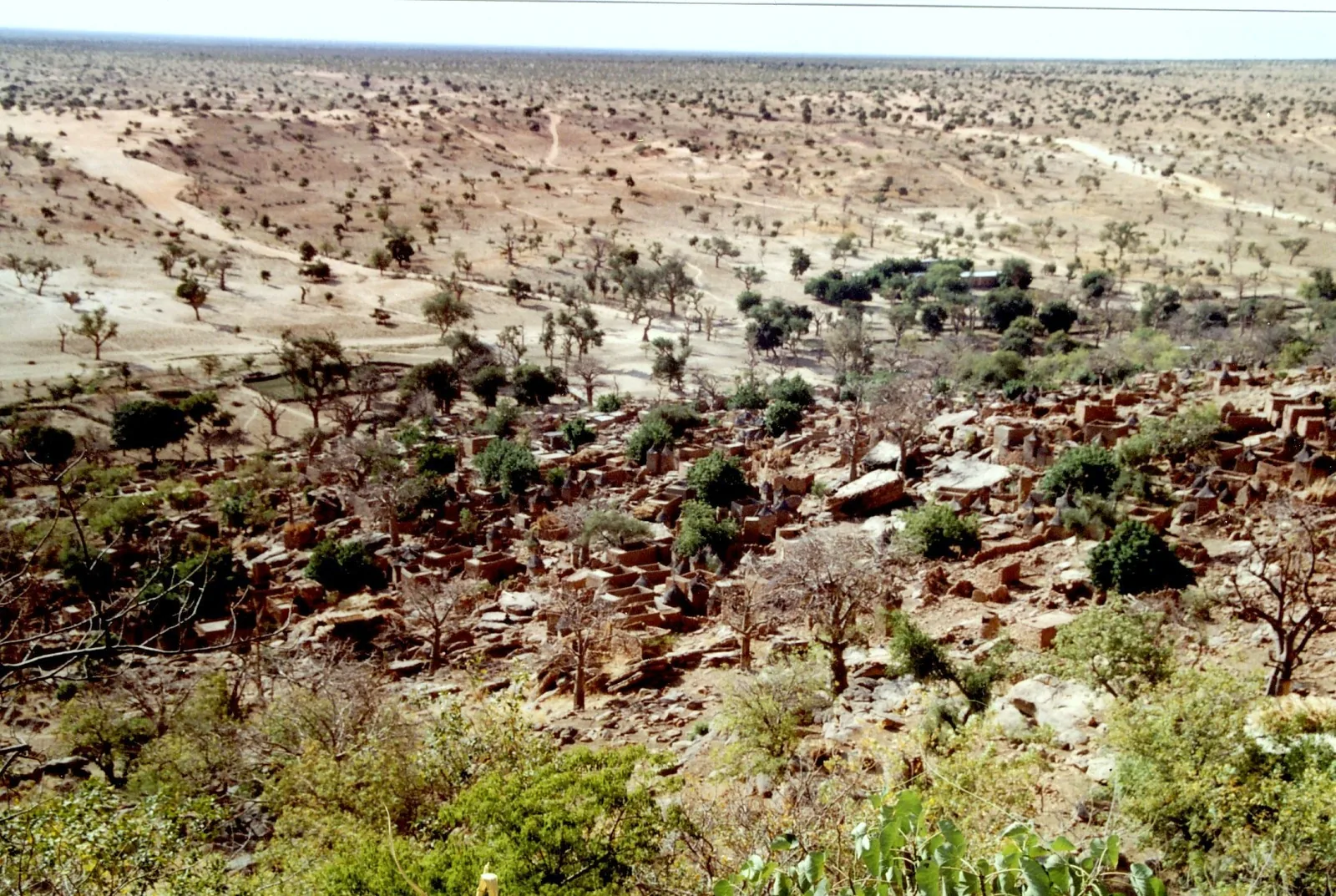
He went looking for the Sirius system and could not find it. The Dogon he worked with called Sirius dana tolo, “the hunter’s star” [5]. “No one, even within the circle of Griaule informants, had ever heard or understood that Sirius was a double star,” he wrote [5]. The people still in that circle disagreed over which star sigu tolo even was: an invisible star for some, Venus for another. “All agree, however, that they learned about the star from Griaule,” van Beek wrote [5].
He offered a reading of how the system formed. Amadingué, who had worked with Griaule’s team at the time, told him about Ambara, one of the men van Beek names as a source of the revelations [5]. Ambara, he said, had spoken of stars of different “generations”: two visible stars beside Sirius, father and son to Sirius as grandfather [5]. Van Beek’s suggestion is that Griaule turned that family tree into a double and triple star [5]. He notes that Griaule had read astronomy during his studies in Paris and knew the peculiarities of Sirius [5]. He notes that Christian missionaries had been in Sanga since the early 1930s [5]. And he is careful about blame: “It is definitely not an individual fraud” [5].
That is the mainstream case, and it is strong. The 1950 paper’s star-science has a documented route to its authors, through a footnote they wrote themselves [1][2]. It has a plausible route through Griaule’s questions, as van Beek describes [5].
What it does not yet have is a documented route to the Dogon themselves. Ridpath, who suspected exactly that kind of contact, had to concede that “there is no mention in the missionaries’ summary reports of their activities that they discussed Sirius with the Dogon” [7]. Opportunity is not a channel.
Van Beek’s critics, printed with his paper, made their own point. R. M. A. Bedaux of the National Museum of Ethnology in Leiden wrote that failing to confirm Griaule’s material decades later “does not a priori mean that Griaule’s information did not obtain at that time” [5]. Geneviève Calame-Griaule, author of a Dogon-French dictionary, published a reply in the same journal later in 1991. It is behind a paywall, we have not read it, and so we do not characterise it here.
Before the Star, the Water
Two years before the Sirius paper, Griaule published Dieu d’eau, “God of Water” [6]. In October 1946 a hunter blinded in an accident, Ogotemmêli of Lower Ogol, summoned Griaule to his house and talked with him over thirty-three days [6]. Griaule writes that Ogotemmêli had waited fifteen years for the chance [6].
At the heart of those talks are the Nommo, the spirits the 1950 paper would call ancestral [1]. In Dieu d’eau they are the first pair God made after a flawed first birth. “God created them like water,” Ogotemmêli says (our translation) [6]. They were green, human from the head to the loins and serpent below, with red eyes, forked tongues and supple arms without joints [6]. Their bodies were smooth and slick, “gliding like a surface of water” (our translation) [6]. Ogotemmêli used the words “water” and “Nommo” interchangeably, Griaule notes [6].
In Dieu d’eau the Nommo carry the Word, the speech that orders the world [6]. The first ancestor, a smith, needed fire before coming down to earth. He slipped into “the workshop of the great Nommo who are the smiths of the sky” (our translation) and stole a piece of the sun as embers and glowing iron [6]. He rode a granary holding the world’s seeds and creatures down a rainbow [6]. The impact at its foot broke his arms and legs at the elbows and knees, joints he had not had before [6]. “So as to work, his arm bent,” Ogotemmêli says (our translation) [6].
What Dieu d’eau does not have is Sirius. The stars in it are “pellets of earth” thrown into space by God [6]. There is no Digitaria, no fifty years, no white star. Even the trickster differs. In 1948 the failed first-born is a jackal [6]. In the 1950 paper he is a pale fox, Yourougou, whose fate is to chase his twin, Yasigui, until the end of time [1].
By 1950 the Nommo had moved into the star system. The paper calls Nommo “Monitor of the new world” [1]. In one drawing from Wazouba, Digitaria is a ring of ten points: the eight ancestral Nommo and the first Nommo couple [1]. One Nommo is sacrificed in the sky, and his twin comes down to earth with the purifying rain [1]. Digitaria itself becomes Yourougou, held in space by Nommo, circling Sirius and never reaching her [1].
Van Beek tested this layer too, and here the field gave a mixed answer. “Each body of surface water has its Nommo, often a pair, male and female, and they are feared as is no other supernatural being,” he wrote [5]. The water spirits were alive in everyday belief. What he could not find, around Tireli, was the Nommo as the key to creation [5].
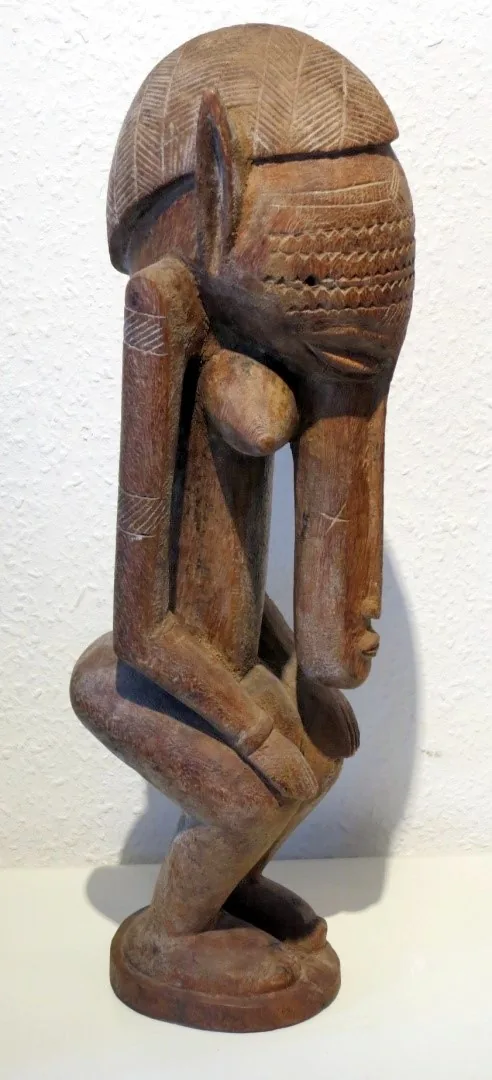
He also found Griaule’s hand in the 1948 book. Griaule writes of himself in the third person. On the thirty-second day, “the White man thought of the Zodiac” but “kept this idea to himself”, hoping the system would emerge on its own (our translation) [6]. Van Beek reads the zodiac link as Griaule’s own [5].
What Is Left When the Star Is Gone
Strip out the items that can be traced to a 1931 article, and something is still standing.

The Sigui still keeps its masks, and the paper’s dates rest on a sixty-year figure that the ethnographers chose [1]. The water Nommo were still feared at every pool around Tireli decades later [5]. The 1946 account still has twin beings made “like water” who carried speech and whose sky-forge gave the first fire [6]. Its first smith still comes down a rainbow and is given joints for work [6]. In the 1950 paper, a man still goes “into” the star and comes back with a new count of time, and the sky is still pushed up out of reach [1].
The mainstream reading handles much of this. A sky that withdraws is, as the 1950 authors note, a belief held by many peoples [1]. An ethnographer with a theory can shape what he hears, as van Beek shows [5]. None of the sources we opened refutes that reading.
Here is another reading, and it is only that. Set the star-science aside as an overlay from the 1930s and 1940s. What remains looks like an older story about teachers who came from the water and handed over speech and craft. It is told by people who also say the sky once hung low enough to touch, and was then pushed away. Readers of our Oannes record will know the outline. Nothing in these documents shows where the Dogon version came from, and no source we opened traces it.
The third star in the footnote can be followed to a telescope in Johannesburg on 4 February 1926. The green, jointless twins in the water lead back to no telescope, and to no source we could find.
Sources
- Griaule, Marcel, and Germaine Dieterlen. "Un système soudanais de Sirius." Journal de la Société des Africanistes 20, no. 2 (1950): 273–294. Persée. https://www.persee.fr/doc/jafr_0037-9166_1950_num_20_2_2611
- Baize, Paul. "Le compagnon de Sirius." L'Astronomie 45 (September 1931): 383–397. NASA ADS scan. https://adsabs.harvard.edu/full/1931LAstr..45..383B
- Bond, Howard E., et al. "The Sirius System and Its Astrophysical Puzzles: Hubble Space Telescope and Ground-Based Astrometry." The Astrophysical Journal 840 (2017): 70. DOI 10.3847/1538-4357/aa6af8. arXiv:1703.10625. https://arxiv.org/abs/1703.10625
- Bonnet-Bidaud, J.-M., F. Colas, and J. Lecacheux. "Search for Companions around Sirius." Astronomy & Astrophysics 360 (2000): 991–996. arXiv:astro-ph/0010032. https://arxiv.org/abs/astro-ph/0010032
- van Beek, Walter E. A. "Dogon Restudied: A Field Evaluation of the Work of Marcel Griaule," with comments and reply. Current Anthropology 32, no. 2 (1991): 139–167. Open copy, Tilburg University. https://pure.uvt.nl/ws/portalfiles/portal/1002365/dogonrestudied.pdf
- Griaule, Marcel. Dieu d'eau: entretiens avec Ogotemmêli. Paris, 1948; Fayard edition, 1975. Les Classiques des sciences sociales. https://classiques.uqam.ca/classiques/griaule_marcel/ogotemmeli_dieudeau/griaule_dieudeau.pdf
- Ridpath, Ian. "Investigating the Sirius 'Mystery'." Skeptical Inquirer 3, no. 1 (Fall 1978): 56–62. https://cdn.centerforinquiry.org/wp-content/uploads/sites/29/1978/10/22165459/p58.pdf
Images are a Hubble Space Telescope photograph (public domain) and field photographs by W.E.A. van Beek, African Studies Centre Leiden, credited and licensed in each caption; none is AI-generated, and no labels or overlays were added. The one speculative reading in the closing section is labelled as such in the text.