
Articles · Ireland · Orkney
The Note in the Stone
In 1994 engineers found that Newgrange and five other Neolithic chambers ring in a narrow band near the pitch of a man’s voice, and in 1998 Maeshowe was measured pulsing at 2 hertz. The physics explains why rooms ring. It explains less well why the best-built tomb rings hardest, and what its makers knew by ear.
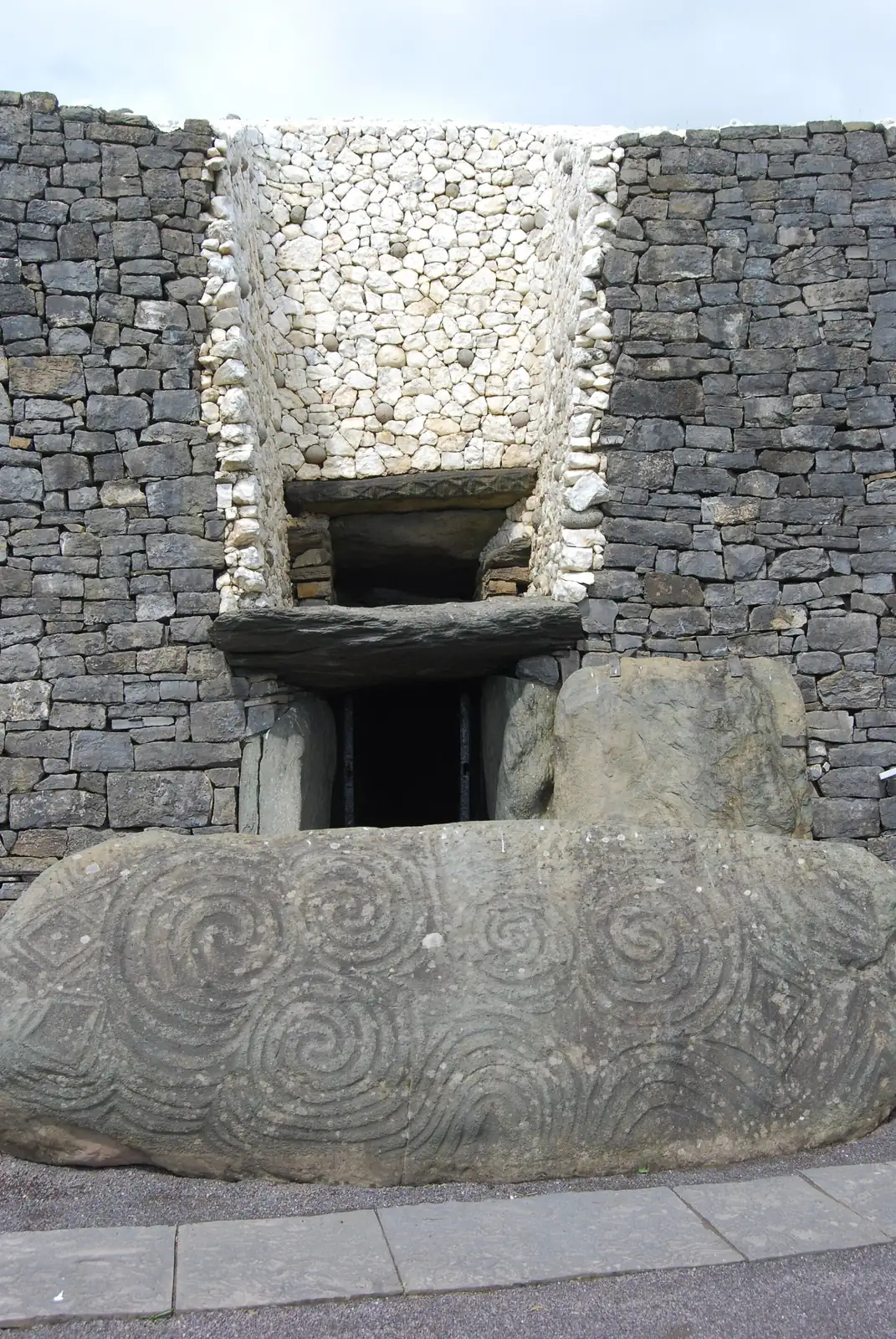
In July 1994, a small research team carried a loudspeaker into Newgrange, set it on a short tripod in the middle of the 5,000-year-old chamber, and slowly turned a dial. At 110 hertz, a low hum close to the pitch of a man’s speaking voice, the tomb answered [1][2]. Along the 19-metre stone passage that leads out to the daylight, the sound settled into about a dozen fixed loops of loud and quiet, laid end to end, in a pattern the team compared to “some gigantic wind instrument” [1].
Newgrange is famous for light. Around the winter solstice the rising sun shines through a slot above its door and down the passage to the chamber floor [3], a story told on this site’s Newgrange record. This is the other half of the building, the half you hear. It is quieter, and in some ways it is stranger.
A Loudspeaker in the Dark
The idea began in the American Southwest. On an informal tour of Anasazi (Ancestral Puebloan) sites, the engineer Robert Jahn of Princeton’s school of engineering and Paul Devereux, a researcher based in Cornwall, had been struck by how the ceremonial rooms called kivas rang [1]. They wondered whether the far older stone chambers of Britain and Ireland did the same. With a Princeton colleague, Michael Ibison, they planned what they called a pilot experiment: ten days in mid-July 1994, six ancient chambers, and a deliberately modest kit [1].
The kit was a loudspeaker, a tone generator, a 20-watt amplifier and a portable sound meter. In each chamber they set the speaker near the centre and swept the pitch through the low range until the room began to reverberate clearly. Then they mapped where the sound swelled and where it died away, though tourists, time limits and cramped spaces meant “only rudimentary maps could be obtained by the experimenters crawling about the cavities” [1]. After a little practice they could tune to a chamber’s resonance blind, to within one or two hertz [1].
What they were mapping has a name. When sound bounces between hard walls, the outgoing and returning waves can lock together into a standing wave: a pattern that stays put, with places of near-silence, called nodes, and places of greatest loudness, called antinodes, fixed in the air [1]. Walk through one and the loudness swells and fades although the source never changes [4].
The results appeared in February 1996 in the Journal of the Acoustical Society of America, a peer-reviewed journal of acoustics [1]. Every one of the six chambers “sustained a strong resonance at a frequency between 95 and 120 Hz, despite major differences in chamber shapes and sizes” [1].
Six Rooms, One Narrow Band
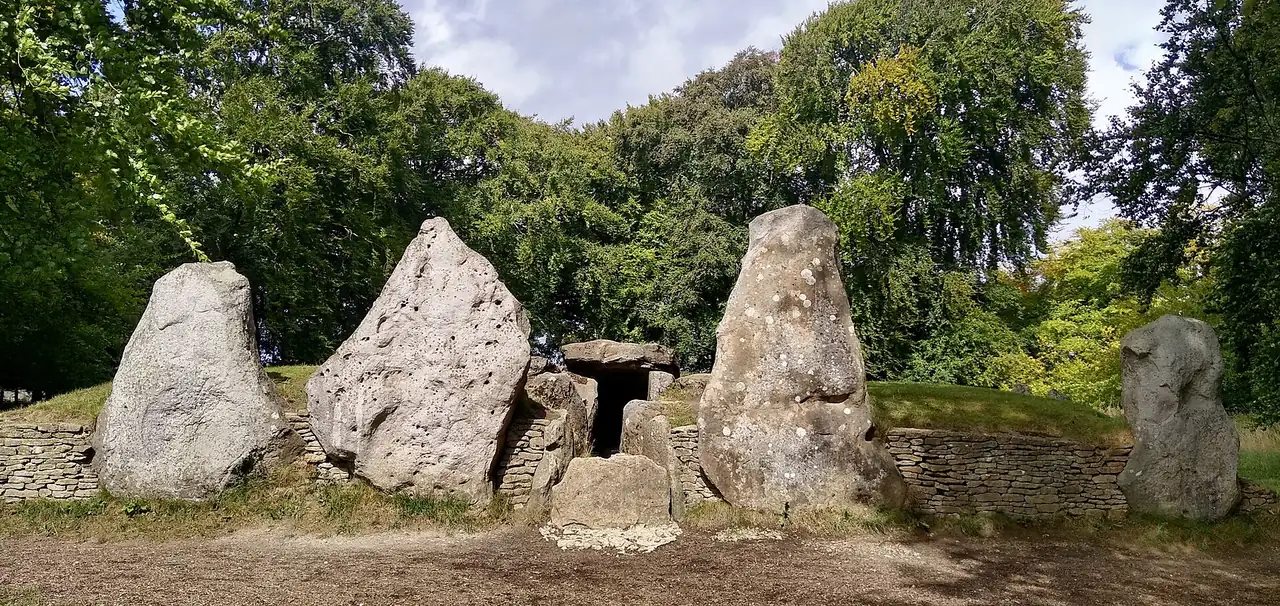
The rooms really were different. Wayland’s Smithy in southern England is a cross-shaped chamber inside a long mound; its east arm rang most strongly at 112 hertz and its west arm at about 95 [1]. Chun Quoit in Cornwall is a small box of four leaning slabs under a capstone, roughly 1.5 metres across, and it rang at 110 [1]. Cairn Euny, a beehive-shaped chamber beneath an Iron Age village of about 400 BC, gave 99 [1]. Two passage tombs on the Loughcrew hills in County Meath, Cairns L and I, gave 110 and 112 [1]. Newgrange gave 110 [1].
That is a tight cluster for rooms ranging from a cupboard-sized dolmen to Newgrange’s cross-shaped chamber, about 6.5 metres across [1]. It is also the pitch of a man talking. A 2022 study of adult Australian English speakers, listed in the University of Sydney voice laboratory’s reference sheet, puts the average male speaking pitch at 115 hertz, with a typical spread of about 21 hertz either way [2]. The female average is 199 [2].
Jahn’s team noticed the overlap at once. The resonances, they wrote, are “well within the adult male voice range,” and “one may speculate” that chanting, swelled by the chamber, served ritual purposes [1]. They added that a man’s voice can put out real power at these low pitches, though the range carries little of what makes speech intelligible [1]. A room that rings there would swell the drone of a chant more than its words.
That single line about chanting has travelled a long way from the journal. The measurements deserve a closer look than the slogans give them, and the first step is some arithmetic.
The Arithmetic of a Human Room
What follows is our own calculation, set out so anyone can check it.
Sound in air travels at about 344 metres per second at 20 °C and a little slower in the cold, 331.5 at freezing, according to Georgia State University’s HyperPhysics reference [5]. Jahn’s team used 344 [1]. Divide that speed by the frequency and you get the length of one wave. At 110 hertz one wave is about 3.13 metres long, and half a wave, the distance from one quiet node to the next, is about 1.56 metres. If a tomb sits near 10 °C, which is our assumption, it shrinks to about 1.54 metres.
Now picture the simplest resonance a room can hold: half a wave fitted between two facing walls. The gap that produces 110 hertz is about one and a half metres. That is roughly the size of the side chambers at Wayland’s Smithy, each about 1.5 metres by 1.5 metres [1]. Jahn’s own model of Chun Quoit, treating its interior as a 1.5-metre box, predicted 113 hertz against the 110 they measured [1].
So the first honest finding is a deflating one. Build a stone room to the scale of the human body, and its lowest strong resonances will tend to land near the pitch of the human voice. The band is not, by itself, a fingerprint of design.
Larger rooms do not escape it either. Maeshowe on Orkney, which Jahn’s team did not visit, has a central chamber about 4.7 metres square and 4.5 metres high, according to Historic Environment Scotland (HES) [6]. Treat it as a perfect box with rigid walls and, by our count, it has 38 possible resonances below 130 hertz, 13 of them between 95 and 120. A room that size has notes to spare in the male range, and a singer will find one.
That might seem to close the case. It does not, because the arithmetic only tells you where a room will ring. It says nothing about how strongly, or about the choices that make one room sing and another merely echo. Those choices are where the builders come back into the story.
What the Numbers Leave Out
Start with the Newgrange passage. It is about a metre wide and two metres high, lined with irregular, carved stones, and it runs 19 metres, rising about 8 percent from the entrance [1][3]. You might expect a passage like that to scatter a sound wave. Instead Jahn’s team traced “some 12 antinode/node pairs” along its whole length, in a clean wave pattern from chamber to door [1].
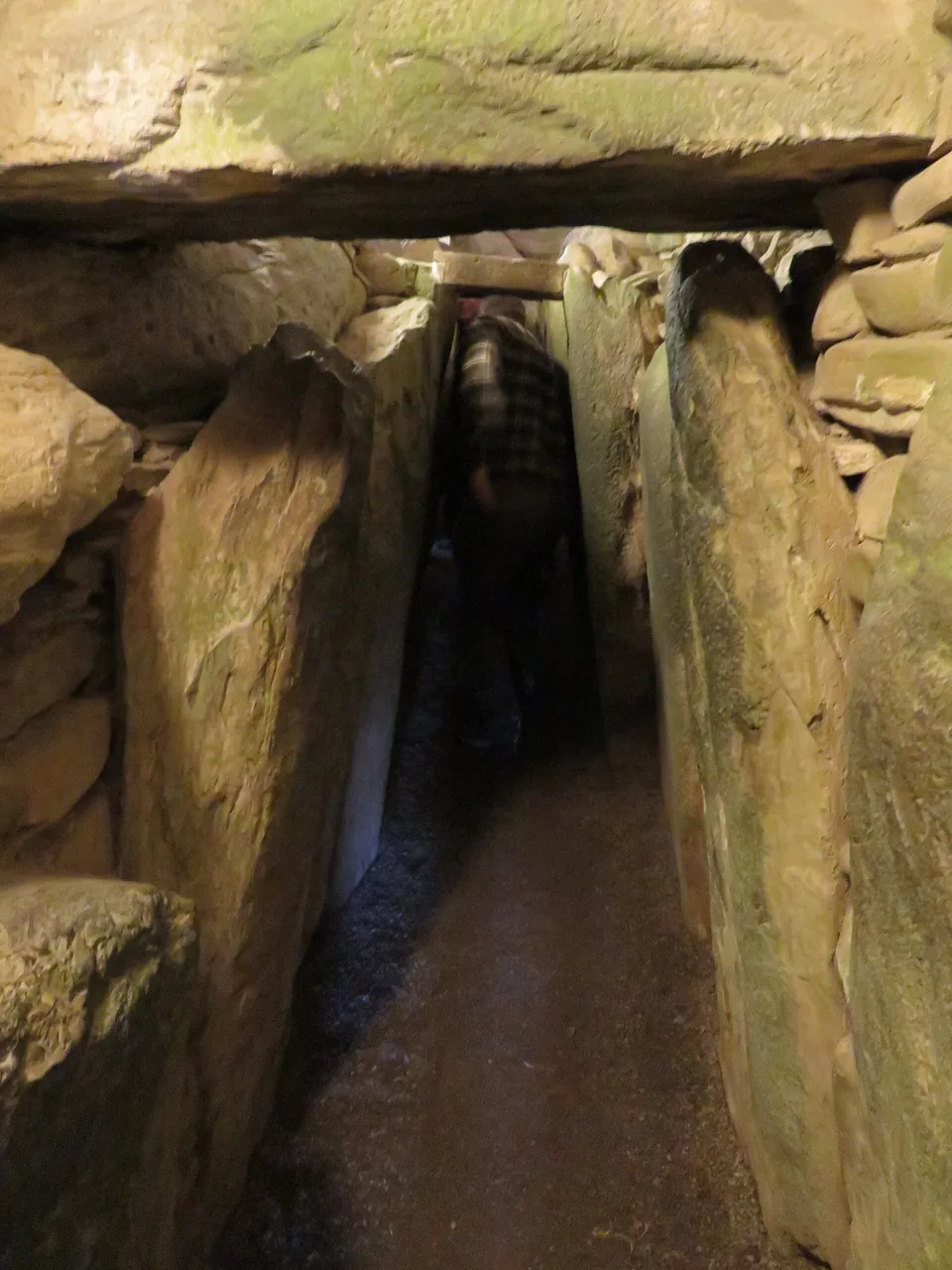
Our check: 19 metres divided by 1.56 metres is a little over 12 half-waves. The count fits a passage acting as one long resonator driven from the chamber, which is what Jahn’s team calculated too [1]. A corridor of rough stones, laid five thousand years ago, behaves like the bore of a pipe.
Then the stones inside. Jahn’s team modelled each chamber mathematically and landed within about 10 hertz of what they measured, though at Newgrange only on a second attempt [1]. At Loughcrew, where upright slabs divide the chamber into small cells, they allowed themselves one bracketed aside: “It is tempting to speculate whether the builders purposely aligned the sector stones to yield a sharper resonance” [1]. In their summary they went a step further: “in a few cases, it appears that interior standing stones may have been positioned to enhance such resonances” [1].
They also reported a coincidence they could not let go. On a corbel in Newgrange’s west recess, two carved zigzag lines have, in their count, “precisely the same number” of peaks and troughs as the standing wave they mapped from the chamber along the passage [1]. That is their observation, not a tested result.
Here the 1996 paper is careful, and the line deserves quoting at the point where enthusiasts usually stop reading. “The extent to which these features were deliberately engineered into these sites, and their particular utilization, are beyond the scope of this study” [1]. The engineers measured an effect. They did not claim a motive.
Maeshowe, the Sealed Room
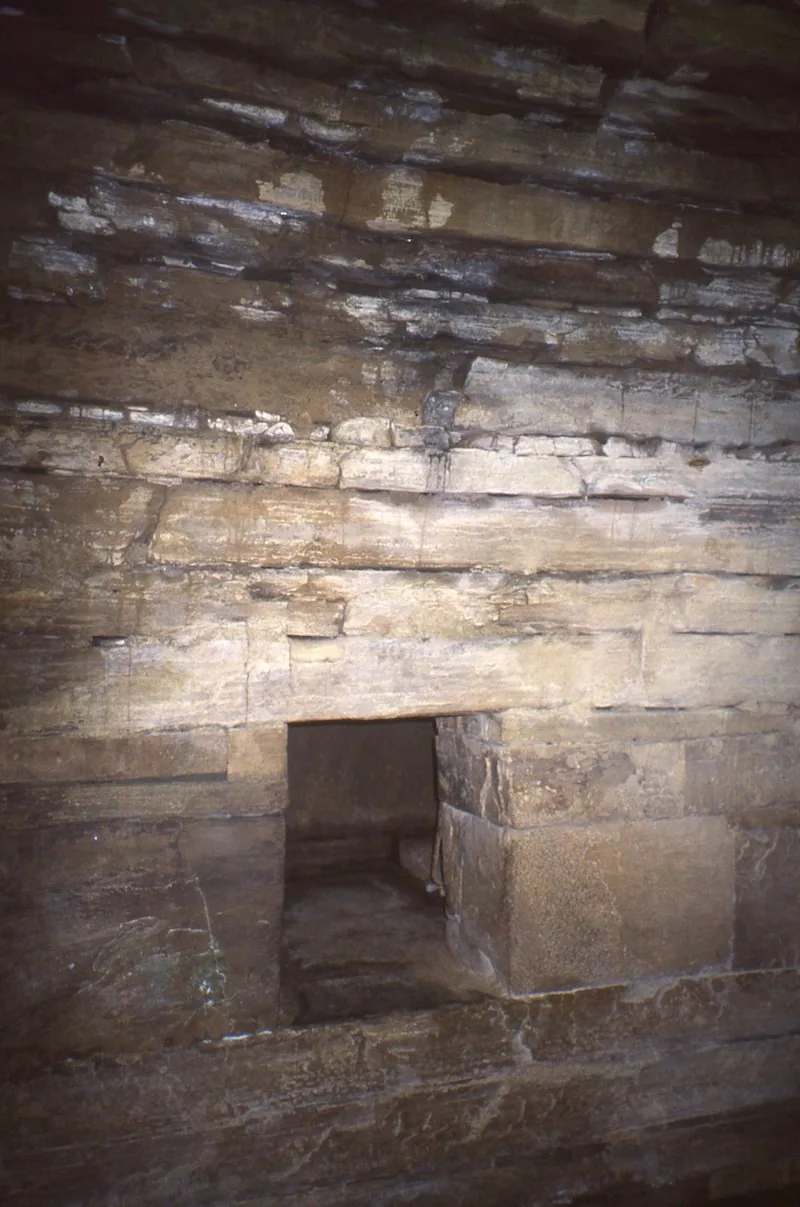
If any chamber was built to hold a sound, it is Maeshowe. HES calls it “the finest Neolithic building to survive in north-west Europe,” raised around 5,000 years ago by people working without metal tools or powered machinery [7]. Radiocarbon dates tentatively place its construction around 2700 BC [6]. From outside it is a grass mound about 35 metres across and 7 metres high [6]. Inside, a long, low passage, each wall formed mostly of a single sandstone slab of up to three tonnes, leads to the square chamber, with a standing stone at each corner and three side cells whose floors, back walls and ceilings are each one slab [7]. HES gives the passage as 10 metres on its visitor page and about 15 metres in its formal statement, which notes that the outer part was rebuilt after the 1861 excavation [7][6].
Oddly for a tomb, almost nothing of the dead was found in it. Excavation recovered a single fragment of human skull, since lost, and HES suggests that such monuments were not necessarily final resting places, more likely shrines to the ancestors or places of ceremony [6].
In 1998 the archaeologist Aaron Watson and the cyberneticist David Keating, both then at the University of Reading, worked inside it with an omnidirectional speaker, oscilloscopes, tone generators and a very sensitive microphone [8][4]. The first thing they noticed was how completely the walls held sound. The masonry is so tightly fitted that it forms an almost unbroken reflecting surface, and the big slabs make whole sections “effectively solid stone” [4].
Humming and chanting set up the strongest standing waves, and the effect was hard to ignore. “Some sounds appeared to move around while the source remained still,” Watson writes, and others grew louder the farther the listener stood from their source [4]. Singers felt the resonance in their own voice boxes, sometimes uncomfortably [4]. The side cells could make a sound seem to come from inside them, an illusion that “might even be controlled with practice” [9].
The shape matters. In advice written in 2004 for a modern chambered mound, Watson and Keating noted that for standing waves “a square would be the ideal shape,” because the same resonance can then build in two directions at once [9]. Maeshowe’s chamber is square [6]. In our box model, the third resonance across one pair of walls and the third across the other land on the same note, 109.8 hertz, and stack. That is a calculation on an idealised room, not a measurement, but it shows what a square plan does. Watson and Keating found standing waves in Maeshowe’s regular chamber “far stronger” than in Newgrange’s irregular one [9].
A Drumbeat the Ear Cannot Hear
Then they went below hearing.
Any closed space with a narrow neck has one natural note of its own. Push extra air in and it springs back out, overshoots, and swings in and out like a mass on a spring; the bigger the space and the longer the neck, the lower the note [10]. A plastic drinks bottle is the textbook example [10]. Physicists call it Helmholtz resonance, and Watson notes that the layout of a passage tomb like Maeshowe is very similar to the classic Helmholtz resonator [4].
Maeshowe obliged. Simply walking around inside generated a pressure wave at 2 hertz, two pulses a second, measured at 120 decibels [4]. A single drum beaten twice a second drove the same pulse past 110 decibels [4]. By our arithmetic a 2-hertz wave is about 172 metres long, far longer than the tomb, so this is not a standing wave at all. The whole body of air in the chamber breathes in and out through the passage like a lung.
At similar levels, Watson writes, 2-hertz sound has been linked with a sense of pressure, headaches, dizziness and disorientation, though “we cannot be too specific,” since people respond in different ways [4]. What a chamber full of drummers felt there is unknown.
Newgrange Stays Silent
In 2001 Watson and Keating took the same test to Newgrange [11]. They found its interior friendly to standing waves, as Jahn’s team had, and predicted a Helmholtz pulse between one and two hertz. Their instruments recorded “no response at all” [11].
The reason, they concluded, was the fabric. Newgrange’s chamber is built of rounded, water-rolled stones that leave gaps, and its great cairn is more permeable; excavations in the 1960s and 1970s found rainwater channels cut into the roof slabs, and a breeze can sometimes be felt in the chamber [11][12][9]. Maeshowe’s regular flagstones are sealed inside a mound of compacted clay [11][9]. One leaks pressure. The other holds it. Watson and his co-author John Was wrote in 2021 that Maeshowe remains “the only Neolithic structure where the effects of Helmholtz Resonance have been empirically measured” [12].
Watson’s own view should be heard in full. He thinks Maeshowe’s infrasound is “an accidental by-product” of the passage-tomb plan, exaggerated by the precise walls, and that “it seems unlikely that this monument was intentionally constructed for this purpose” [4]. With Was he repeats it: not intentional, “even at Maeshowe” [12].
Here is our reading, and it is only a reading. The two tombs faced the same test and gave opposite results, and the difference traces to construction choices: square or rounded, flagstone or boulder, clay-sealed or drained. Whatever its builders intended, Maeshowe was made with the materials and the geometry that turn a room into a pressure vessel, and it is the one tomb where anyone has measured that effect.
There is one more opening to consider. At Maeshowe, a large blocking stone sits in a recess built to hold it [6], and even with the entrance sealed by that stone, a narrow gap remains between its top and the passage ceiling [4]. Watson and Keating considered whether people outside could send sound in through it. At Newgrange, Watson points out, there is “an open slot above the passage entrance” that could have been used the same way [4].
That slot is the roof-box, the opening that admits the midwinter sunrise [3]. Here is a guess, and it is only a guess: Newgrange’s famous window for light may also have been a mouthpiece. We found no published recording of what a drum or a voice at the roof-box does to the chamber 19 metres away, and it is a measurement anyone with access could make.
The 110-Hertz Brain
In 2008 three researchers at the University of California, Los Angeles, took the chamber numbers into a laboratory [13]. Ian Cook, Sarah Pajot and Andrew Leuchter played tones at 90, 100, 110, 120 and 130 hertz to 30 healthy adults while recording their brain activity with EEG, electrodes on the scalp [13]. At 110 hertz, activity over the left temporal region dropped significantly compared with the other tones, and the balance of activity at the front of the brain shifted from left to right [13]. The authors read this as compatible with “relative deactivation of language centers” and called it a set of “pilot findings” deserving a wider study [13].
That is as far as the evidence goes, and the field researchers are wary. Watson and Was write that “there is no robust scientific evidence that single frequencies can trigger specific physiological effects,” and that the 2008 study shows “some significant inconsistencies” [12]. They add a musician’s objection: if one tone had special power, players over the millennia would have found it and used it [12].
A more careful kind of test does exist. In 2017 a team of acousticians and archaeologists measured five decorated caves in northern Spain, whose images may be up to 40,000 years old, to see whether the art sat where the rock resonated [14]. Lines and dots were statistically more likely to appear where low-frequency sound showed resonant behaviour, and the authors judged the link “a statistically weak but tenable hypothesis” [14]. An appreciation of sound, they concluded, could have influenced how those Palaeolithic people behaved [14].
The Mainstream Case at Full Strength
The strongest sceptical account runs like this, and it is a good one. Every enclosed stone room resonates. Build rooms to fit bodies and they will ring near the pitch of voices, and the people inside will hear it, use it and give it meaning, without anyone designing it [1][9]. The measurements are real but few: one season of rough hand-mapping at six sites in 1994, a few later field visits, no published infrasound result for Newgrange, and one small brain study [1][12][13]. The researchers who did the work are the first to say that intent cannot be shown [1][4][12]. HES’s own position is measured: tombs “can create a range of acoustic effects, which may have been used to heighten the atmosphere” in ritual [6].
Even the newest research fits the softer version. In September 2026, Jacqueline Ortoleva and Maurizio Forte reported that two Etruscan painted tombs of the 5th century BC, one with exceptionally long reverberation, were “designed and constructed not simply to house the dead, but to affect the living” [15]. They suggest it may be time to rethink funerary architecture “throughout the ancient Mediterranean and beyond” [15]. That credit goes readily to the Etruscans. Whether it reaches more than two thousand years further back, to people who left no writing at all, is the question this piece has been circling.
What the accidental account struggles with is accumulation. It explains why a room rings. It explains less well why the building HES ranks as the finest of its age in north-west Europe is also square, also clay-sealed, and also the only one where the air itself has been measured pulsing [7][9][12]. It does not say why engineers measuring Loughcrew thought its standing stones may have been placed to sharpen the resonance, or why Newgrange’s slot for light is also its most obvious path for sound [1][4]. Each could be chance. Together they look like the residue of practice: people who sang in stone rooms for generations and learned, by ear, what made a room answer.
What They May Have Known
If that is right, and nobody has tested it, then Neolithic Ireland and Orkney held a working knowledge of sound that left no written trace. Not equations. Something closer to a craft secret, the kind a master passes to an apprentice: square the chamber, seal the mound, set the stones just so, leave a gap above the door. UNESCO calls the Orkney monuments “technologically ingenious and monumental masterpieces” [16]. Their acoustics suggest the ingenuity reached past what the eye can see.
Tests could settle it, and these are our suggestions. Measure the Orkney tombs built in Maeshowe’s style and see whether square chambers ring harder than irregular ones. Model Loughcrew with and without its partition stones. Repeat the Helmholtz test at other clay-sealed tombs. Record what a voice or a drum at the Newgrange roof-box does inside the chamber. Each is cheap, repeatable, and capable of a clear answer.
Until then, the effect is measurable and the intent is open. Hum low in Maeshowe’s square chamber and, as Watson and Keating found, the room takes up the note [4], five thousand years after someone fitted its stones. Somebody, once, was the first to hear that. Who taught their descendants to build for it, and where that knowledge went, the stones have not said.
Sources
- Jahn, R. G., Devereux, P., Ibison, M. "Acoustical resonances of assorted ancient structures." Journal of the Acoustical Society of America 99(2) (1996): 649–658. https://doi.org/10.1121/1.414642
- Sydney Voice Lab, University of Sydney. "Acoustic Analysis Normative Data Reference Sheet" v4.0 (2025), citing Leung, Oates, Papp & Chan, Journal of Voice 36(3) (2022). https://www.sydney.edu.au/content/dam/corporate/documents/faculty-of-medicine-and-health/research/research-centres/sydney-voice-lab/acoustic-analysis-normative-data-reference-sheet-20250416_v4.0-sydney-voice-lab.pdf.coredownload.pdf
- World Heritage Ireland (Office of Public Works / Department of Housing, Local Government and Heritage). Winter Solstice Phenomenon at Newgrange: Research Report (2024). https://www.worldheritageireland.ie/wp-content/uploads/2024/12/1314_World-Heritage-Unit_Winter-Solstice-Research-Report_Final.pdf
- Watson, Aaron. "Maeshowe" (acoustic fieldwork account). https://www.aaronwatson.co.uk/stones-of-stenness-1
- Nave, C. R. "Speed of Sound in Air." HyperPhysics, Georgia State University. http://hyperphysics.phy-astr.gsu.edu/hbase/Sound/souspe.html
- Historic Environment Scotland. Maeshowe Chambered Cairn: Statement of Significance (updated 2025). https://www.historicenvironment.scot/publications/all/publication/?publicationId=9c5786c0-ec08-49b1-9a56-a57000d89587
- Historic Environment Scotland. "Maeshowe Chambered Cairn: History and stories." https://www.historicenvironment.scot/visit/all/maeshowe-chambered-cairn/history-and-stories/
- Watson, A., Keating, D. "Architecture and sound: an acoustic analysis of megalithic monuments in prehistoric Britain." Antiquity 73(280) (1999): 325–336 (abstract and author details). https://www.cambridge.org/core/journals/antiquity/article/architecture-and-sound-an-acoustic-analysis-of-megalithic-monuments-in-prehistoric-britain/F37AF50641B26AC288BA756A1C12EA33
- Watson, A., Keating, D. "Comments by Watson and Keating" on the acoustics of a proposed chambered mound (2004), Earth Sanctuary. https://earthsanctuary.org/wp-content/uploads/2024/10/Comments-by-Watson-and-Keating.pdf
- Nave, C. R. "Cavity Resonance." HyperPhysics, Georgia State University. http://hyperphysics.phy-astr.gsu.edu/hbase/Waves/cavity.html
- Watson, Aaron. "Newgrange" (acoustic fieldwork account). https://www.aaronwatson.co.uk/newgrange
- Watson, A., Was, J. "Notes on Chambered Mound" (27 May 2021), Earth Sanctuary. https://earthsanctuary.org/wp-content/uploads/2024/10/Notes-on-Chambered-Mound-by-Aaron-Watson-and-John-Was-27May2021.pdf
- Cook, I. A., Pajot, S. K., Leuchter, A. F. "Ancient architectural acoustic resonance patterns and regional brain activity." Time and Mind 1(1) (2008): 95–104 (abstract via OpenAlex; affiliations via Crossref). https://doi.org/10.2752/175169608783489099
- Fazenda, B., Scarre, C., Till, R., et al. "Cave acoustics in prehistory: Exploring the association of Palaeolithic visual motifs and acoustic response." Journal of the Acoustical Society of America 142(3) (2017): 1332–1349 (CC BY 4.0). https://eprints.hud.ac.uk/id/eprint/31777/
- Ortoleva, J., Forte, M. "Confronting demons: how acoustic and AI technology brought ancient Etruscan tombs back to life." The Conversation, 30 Sep 2026. https://theconversation.com/confronting-demons-how-acoustic-and-ai-technology-brought-ancient-etruscan-tombs-back-to-life-293119
- UNESCO World Heritage Centre. "Heart of Neolithic Orkney." https://whc.unesco.org/en/list/514/
Calculations (wavelengths, half-wave spacings, room-mode counts for an idealised Maeshowe box, the 2-hertz wavelength) are ours, from the speed of sound in source 5 and dimensions in sources 1 and 6. For sources marked "abstract," only the published abstract was read. Source 1 was read in full from a scan of the published article; the DOI is the citation.
Not opened (named only through other sources): Devereux and Jahn, Antiquity 70 (1996): 665–66; Watson, "Sounds of transformation" (2001); Watson and Keating (2000); Till, Antiquity (2017) on the Hal Saflieni Hypogeum; Debertolis's Hypogeum studies; Devereux's books; the full text of source 13 (abstract only) and of source 8 (abstract only).
Images are photographs by jemartin03 (CC BY 2.0), Mertbiol (CC0), O’Dea (CC BY-SA 4.0) and Richard Webb (CC BY-SA 2.0), via Wikimedia Commons and Geograph, credited and licensed in each caption; they were resized or converted to WebP only, none is AI-generated, and no labels or overlays were added. The CC BY-SA images are shared here under the same licences. The video is included for viewing and is not cited as a source. Inferences and speculation are labelled as ours in the text.