Move It Yourself: Put an 800-Tonne Stone in a Wall
Ten people can drag a three-quarter-tonne stone. Pick a Baalbek block, choose the ground and the slope, and walk a true-scale crew to the wall. The maths works. That is when Baalbek gets strange.
About 12 min7 sources3D haul scene
In 2016, ten people dragged a three-quarter-tonne stone across a garden in London on a wooden sledge.1 In Lebanon, three stones sit side by side in one wall, and each weighs roughly 800 tonnes.2
Nobody knows for certain how they got there. Try it yourself.
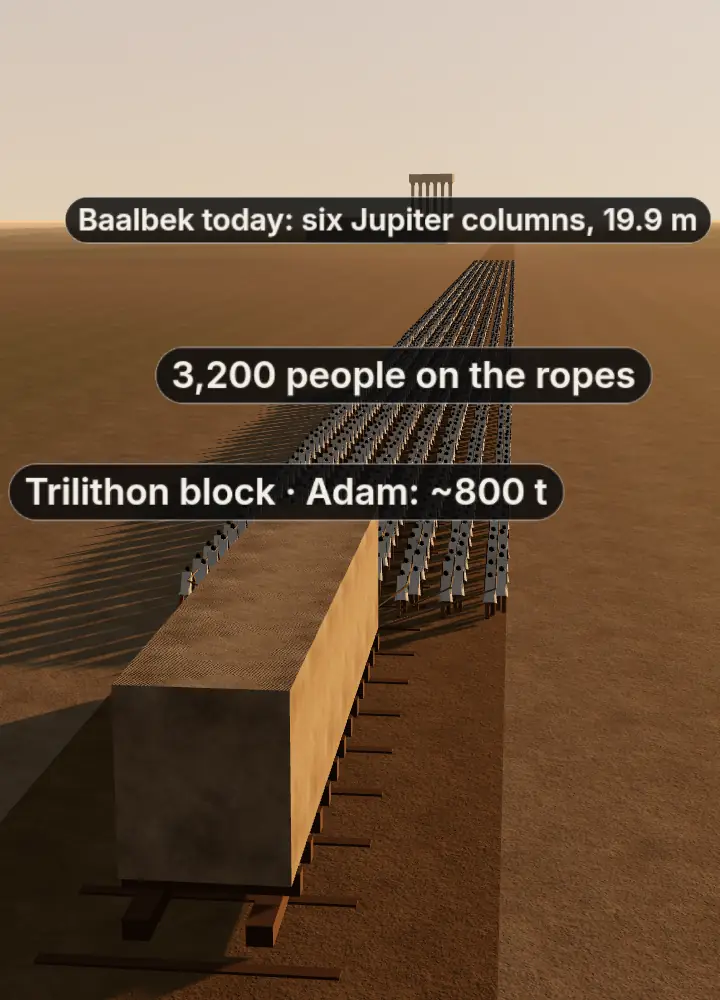
The Haul: 3D haul scene
≈ 3,200people pulling
True scale. Crew layout illustrative.
Drag to look around. Pinch or scroll to zoom. Tap or click a stone, a surface or a slope. On a phone, tap the scene first so the page keeps scrolling; Done hands it back.
3D is not available on this device, so the still picture stays. The crew count and the maths still work.
Stone
Shapes other than the Baalbek blocks are illustrative.
Surface
Method
Adam 1977 reconstructionAdam’s machines apply to the Trilithon only.
Trilithon block, wet clay, flat: about 3,200 people.
Show the math
Pull needed F = W × (μ·cos θ + sin θ) = 800,000 × 0.2 = 160,000 kgf. Crew = 160,000 ÷ 50 kgf per person (assumption, Protzen) = 3,200.
Drawn to Wiegand’s survey of the northern stone: 19.00 m long, 4.16 m high, 3.60 m deep. The three stones measure 19.00, 19.75 and 18.35 m (Wiegand 1921); Adam gives 19.60, 19.30 and 19.10 m × 4.34 × 3.65 m.
Put it in.
The block has reached the west podium wall, drawn to Wiegand’s 1921 survey. Choose how it goes in.
Within a hand’s width. That’s the game; no source we opened gives a joint gap.
Start small
The London stone was a concrete stand-in for a Stonehenge bluestone. The archaeologist Barney Harris put it on a simple sledge and ran it over logs laid as a fixed track. It took "only ten people," he wrote, and it moved "with some speed."1 Our record: /r/STO-HEN.html.
The calculator in the scene uses the same physics. The pull you need is the stone's weight times the friction of the ground, plus a share of the weight if you go uphill.
The researcher Jean-Pierre Protzen measured those frictions for the Inca roads at Ollantaytambo, in Peru. He built test surfaces copying them and dragged a 42-kilogram block across each with a spring gauge. Compacted dirt gave 0.75. Broken-rock ballast gave 0.7.3
He also assumed that one person can pull steadily with about 50 kilograms of force. On those numbers, the largest block left in the Inca quarries, 106 tonnes, needed "some 1,780 people" to drag it up an 8° ramp.3 Wetting the clay roadbed, he worked out, could bring that down to 715.3 Our record: /r/OLL-OLL.html.
Now pick the big one
Tap or click the Trilithon block. Leave it on flat ground and choose Protzen's wet clay, a friction of about 0.2. The crowd on screen is about 3,200 people. Switch to compacted dirt and it grows to about 12,000 (our arithmetic: 800 tonnes × friction ÷ 50 kg per person).23
That looks like the point where the story breaks. It doesn't. Not yet.
The stone that proves it can be done
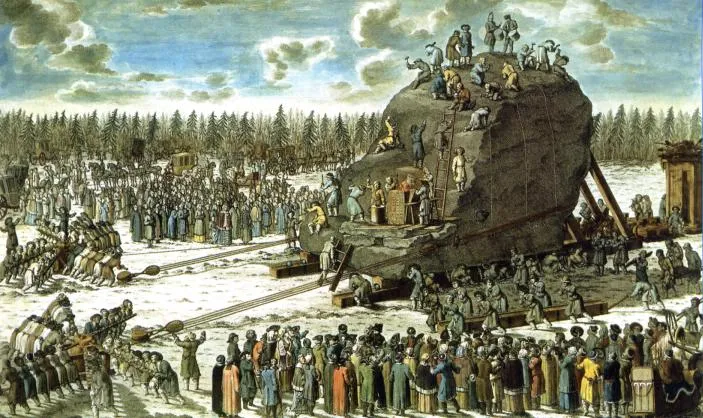
Catherine the Great had a granite block hauled to St Petersburg to serve as the base for a statue of Peter the Great. The land haul began on 1 April 1769. The Encyclopaedia of Saint Petersburg puts the stone at 1,600 tonnes at that point.6 Jean-Pierre Adam, in a 1977 engineering study of Baalbek's stones for the journal Syria, gives 1,250 tonnes. He calls it probably the heaviest stone ever moved by human beings, one and a half times a Trilithon block.2
The Thunder Stone on its way to St Petersburg. Engraving by I. F. Schley after Y. M. Felten, 1770.
The pulling crew was tiny. The engineer, Marin Carburi (Adam spells it Carbury), set the block on a timber sledge. It ran on metal balls 13.5 centimetres across, rolling in grooved tracks.27 Two capstans did the pulling, and Adam counts 32 men on each. That is 64 men on the ropes for about 6 kilometres, over ground they waited to freeze.2
Many more hands laid track and carried the balls forward. Accounts of the pace differ, from six weeks (Adam) to about five months at a little over a mile a month (the Linda Hall Library).27
So muscle is not the wall. Machines shrink the crowd.
Adam's answer for Baalbek
Adam applies the same logic to the Trilithon. The quarry lies about 800 metres away and a little higher than the temple, so the first courses went gently downhill.2 In his reconstruction, each block rolls on cedar rollers over a timber roadway. Six capstans worked by 144 men pull it.2
What about getting it up into the wall? Adam's answer is that nobody lifted it. The roadway was raised on a construction fill each time a course was finished, so every block arrived at its own level by pulling alone.2
The last few metres are the hardest. The rollers have to come out, and the bare stone slides on a bed made slippery with wet clay. For that, Adam calls for 16 capstans and 512 men per block.2
Adam 1977 reconstruction
His conclusion is confident. He believes he has brought "the irritating question" of how the stones were placed down to graspable, "not to say human," dimensions.2 The steelman is strong, and it deserves to be.
At the wall
Now walk your crew to the end of the scene. The German excavators who surveyed the temple in the early 1900s recorded the wall in detail.4
The foundation tops out at the ancient ground level. On it sits a course of blocks 3.90 metres high and about 9.5 metres long. The three giants rest on top of that: 19, 19.75 and 18.35 metres long, 4.16 metres high and 3.60 metres deep.4 Their undersides sit roughly four metres above the old ground (our reading of the survey).4
Adam himself says the stones were set "with remarkable precision."2 Neither study we opened cites any ancient account of how.
What the calculator can't see
Here is the strange part, and it is in the excavation report itself.
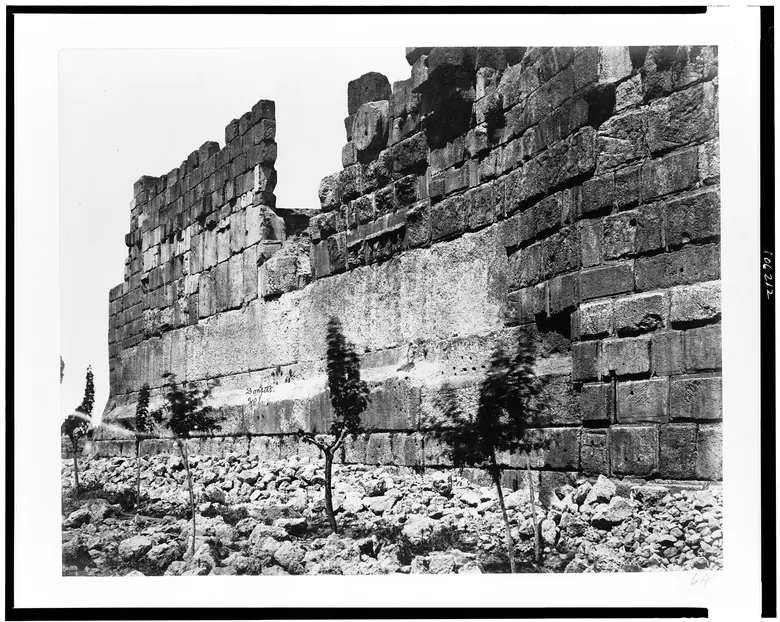
Apart from the outer face, the German team wrote, every side of the three stones is almost entirely hidden behind later Arab masonry. Any technical details that might explain the transport and the lifting of the giant blocks are therefore out of reach.4 On the visible face they found a single square hole, near the edge of the northern stone.4
"Baalbec. The three great stones." Photograph by Félix Bonfils, about 1870. Medieval masonry rises above and around the ancient blocks.
That was the record in 1921, and the 1977 study we opened does not report anything new from those hidden faces. So Adam's ramp is a reconstruction, built from machines known in antiquity. His mathematics, he explains, is there to justify the efficiency of those known machines and methods.2 It answers "could they?" The evidence for "did they, and how?" is still behind a wall.
Built once
The scale is the other thing the calculator can't explain. Adam, the engineer making the mainstream case, writes that so many stones of such outsized dimensions are "unique, dans toute l'Antiquité": unique in all of antiquity.2
The work also stopped. The excavators found the Trilithon's course partly prepared on the north and south sides but never laid. The podium never reached its planned height of more than 12 metres. Why work stopped at this point and never resumed "ist unbekannt," they wrote: it is unknown.4
A fourth giant still lies in the quarry, 21.5 to 21.7 metres long, meant for the same building. Adam puts it at 970 tonnes and the German survey at 1,211 tonnes. Their measurements match, so we take them to be the same stone.24
Adam's explanation for the scale is power. Rome, he says, wanted a sanctuary in this old Phoenician land that outdid anything the local, megalith-loving builders had made, to show the Empire's might.2 That is a real motive. But it raises a question it can't answer. If this was the way to impress, why did no one in antiquity do it again?
Adam also notes that the work, while it corresponds to a Roman programme, belongs technically to a Phoenician tradition. He chooses not to take up the question of dating.2 Our record of the site's phases: /r/BAA-TRI.html.
The question Adam left
Adam's last page is not about muscle at all. He says an archaeological problem remains: to determine by whom, and when, these techniques first appeared.2 Egyptians, he notes, did not know the pulley. He guesses at seafarers, Minoan or Phoenician, and hopes underwater archaeology will one day settle it.2
Here is our speculation, and it is only speculation. The calculator proves people could move these stones. It cannot tell you who first knew how, or why the knowledge shows itself at this scale only once, in one wall, and then stops.
Haul your block to the wall and look at its neighbours. Who decided that 800 tonnes was the size of a building stone?
Share your haul. The card is our own flat drawing of your block and its crowd, and the link reopens your exact settings.
Sources
Barney Harris, "Moving megaliths: Time to park the rollers", author's accepted manuscript, UCL Discovery (UCL Institute of Archaeology), eprint 10114174. https://discovery.ucl.ac.uk/id/eprint/10114174/
Jean-Pierre Adam, "À propos du trilithon de Baalbek. Le transport et la mise en œuvre des mégalithes", Syria 54 (1977), pp. 31–63, doi:10.3406/syria.1977.6623. Opened on Persée, pp. 42–44, 51–52, 54–62, 63. https://www.persee.fr/doc/syria_0039-7946_1977_num_54_1_6623 (translations ours)
Jean-Pierre Protzen, Inca Architecture and Construction at Ollantaytambo (New York: Oxford University Press, 1993), ch. 9, "Transporting", pp. 179–181 (cited bibliographically).
Theodor Wiegand (ed.), Baalbek: Ergebnisse der Ausgrabungen und Untersuchungen in den Jahren 1898 bis 1905, vol. 1 (Berlin and Leipzig: de Gruyter, 1921). Sections on the quarries and on the temple podium; full text via Internet Archive (Getty Research Institute copy). https://archive.org/details/gri_33125008088375 (translations ours)
Thunder Stone.jpg. Engraving by I. F. Schley after a drawing by Y. M. Felten, about 1770, "The Transportation of the Thunder-stone in the Presence of Catherine II". Public domain (verified on the Commons file page). https://commons.wikimedia.org/wiki/File:Thunder_Stone.jpg
3D scene, poster and share card: our own renders and drawings. The wall follows Wiegand’s 1921 survey; the crew count follows the formula shown; the crew layout is illustrative.