
Articles · Peru · Paracas
What the Paracas Skulls Remember
The “alien DNA” story about Peru’s elongated skulls, read against the Ministry of Culture’s own file, comes back human. The deeper puzzle is the custom itself: more than ten thousand years old, on several continents, and explained once, in 1586, by people who said their heads were shaped like the mountain they came from.
On a January day in 1586, in the highland town of Yanqui, the lords of the Collaguas told a Spanish magistrate why their babies’ heads were long. Their people had come out of a mountain [1].
The magistrate, Juan de Ulloa Mogollón, had called together the chiefs and elders of the province, the parish priests and the resident Spaniards to answer a questionnaire from the king [1]. The answers his scribe wrote down that day are plain and strange. The Collaguas said they descended from a snow-capped peak shaped like a volcano, called Collaguata, which they had worshipped since ancient times. “From this mountain, or from inside it, many people came out,” the scribe recorded, and those people marched down into the valley, beat the natives and took their land (our translation) [1].
Then came the detail that matters most here. Until the general inspection ordered by the viceroy Francisco de Toledo, the Collaguas wore tall brimless hats, and to make the hats sit they bound the heads of newborns so tightly that they grew tall, thin and as long as possible. They did it, the record says, “in memory, that their heads should have the high form of the volcano from which they came out” (our translation) [1]. By 1586 the custom was forbidden by ordinance.
Here, set down within living memory of the custom, is an explanation of Andean head shaping given by the people who practised it [1][2]. Hold on to it. Four centuries later, people are still putting questions to the long heads of Peru, and lately they have been asking with a drill.
Eight Skulls in Ica
In September 2016, Peru’s Ministry of Culture gave an archaeologist named Rubén García Soto four weeks to take samples from skulls stored at the Museo Regional de Ica, a regional museum on Peru’s south coast [3]. The plan was to extract mitochondrial DNA, the small genome a child inherits only from its mother, and test whether the people of late Paracas times had developed locally in the Ica region [4][5].
The report García filed in March 2018 is a public document, hosted on the Ministry’s own website, and it is more candid than most of what has been said about it since [4]. Eight skulls were chosen. Five came from Chongos, a large ancient settlement on the south bank of the Pisco river, and had been picked up from the surface of looted burial grounds in the 1970s. Three came from a tomb at Cerro Colorado on the Paracas peninsula that robbers had broken into in 2004 [4].
Museum staff carried the skulls from the storerooms to a work room, and the samples were taken there. A tube-shaped hole two to three millimetres wide beside the foramen magnum, the opening where the spinal cord enters the skull, was drilled to collect bone powder. Hair was pulled out strand by strand, and a piece of scalp and a tooth were added: 30 samples in all [4]. The project head took the samples, the report says, assisted by an American archaeologist, Armondo Gonzales, and by Dr. L. A. Marzulli, director of an American group called Spiral of Life, which paid for the whole project [4].
Hold that scene in mind too: a museum work table, a fine drill, hair pulled by hand, and a question about who these people really were.
What the Long Heads Are
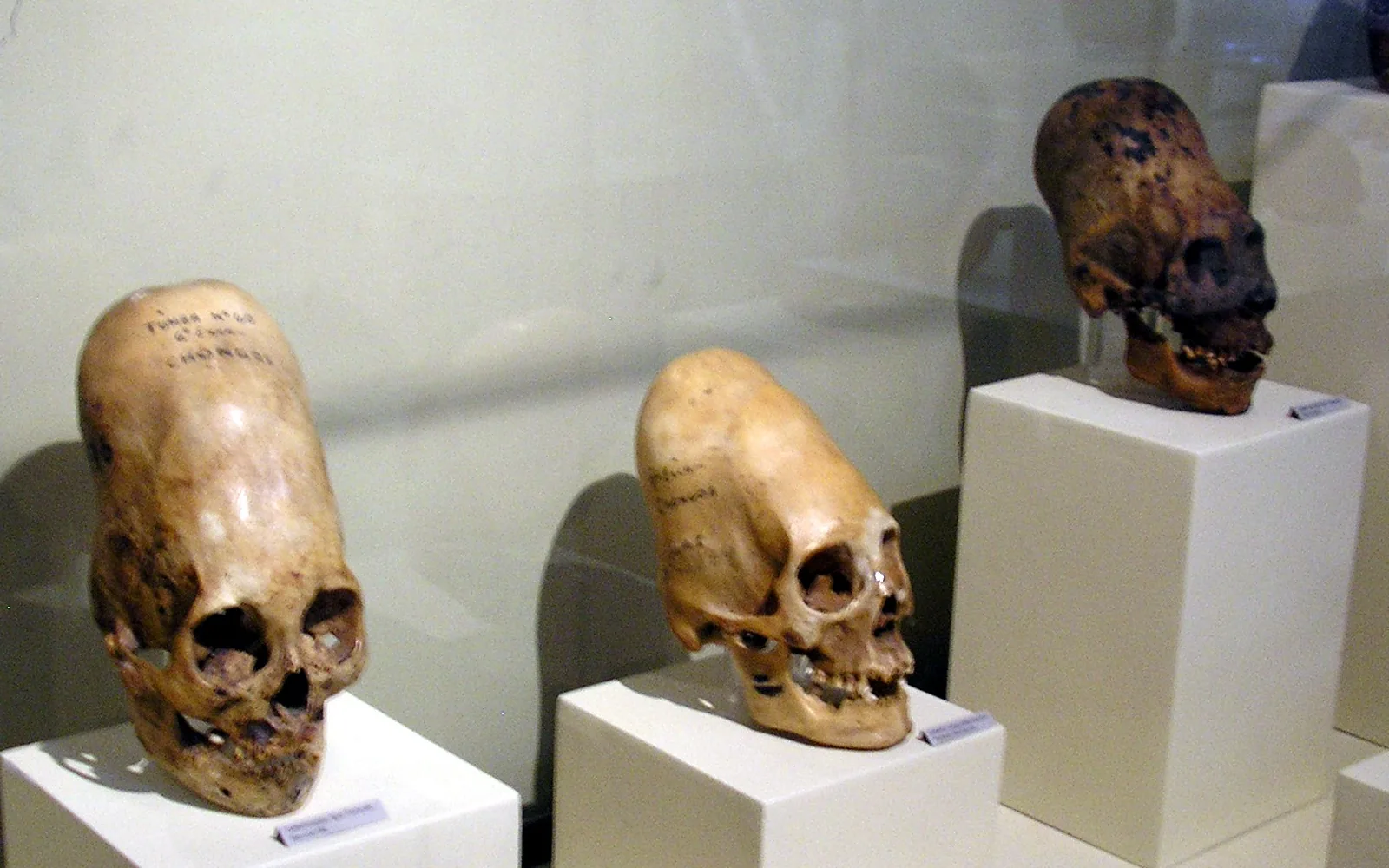
The skulls on that table belong to one of the most striking burial records in the Americas. The Paracas culture flourished on the south coast of Peru from roughly 800 BC into the first century AD [6][7]. At Cerro Colorado, an ochre sand hill 124 metres high at the neck of the Paracas peninsula, its people dug tombs, caverns and a great necropolis for more than a thousand dead [7]. The Peruvian archaeologist Julio C. Tello found the site in the 1920s, guided there in 1925 by a looter, after superb textiles began to surface on the open market [6][7].
The heads are the part the world remembers. A 2022 study of 159 individuals from the Paracas Cavernas phase, about 550 to 200 BC, found intentional cranial modification in 98 percent of them [8]. Women more often had a two-lobed shape, 34 percent against 19 percent of men, and the shapes showed no pattern by wealth or status [8]. The French archaeologist Lucie Dausse, who re-examined 311 Paracas dead, found the tools in the graves themselves: cloth bandages, cotton pads and reed cradles [7].
Our record on the Paracas elongated skulls follows Tello into the caves where some children still wore their bindings. This piece takes up a different question: what the shape was for, and how far back it goes.
The Claim, in Its Own Words
The idea that these heads are not human did not begin in a laboratory. It began in a pair of articles on the website Ancient Origins in February 2014.
The first announced that a DNA analysis had been run on one Paracas skull. It stated that “the cranial volume is up to 25 percent larger and 60 percent heavier than conventional human skulls,” and that the skulls have “only one parietal plate, rather than two” [9]. It gave no measurements, no sample size and no method for any of those figures [9]. Samples had been taken from five skulls at a local museum, the Paracas History Museum, samples from three went to a geneticist, and a result had come back from one [9]. Through the author Brien Foerster, the geneticist was quoted as finding “mtDNA (mitochondrial DNA) with mutations unknown in any human, primate, or animal known so far” [9].
The geneticist was not named [9][10]. In the interview published three days later, Foerster said he had wanted the testing done independently, not through any governmental or private foundation, and when asked whether the result might be contaminated, he answered, “It is possible” [10]. No peer-reviewed paper reporting that result appears in any source we opened.
Note what Foerster also said in that interview. Doctors had told him, he explained, that “you can alter the shape of the skull but you cannot increase the size of the skull” [10]. Keep that sentence in view. It turns out to be the most reliable thing in the 2014 claims.
Five Results From Thirty Samples
The Ministry file is where the DNA story can be checked against paper. Of the 30 samples sent abroad, the report says, “only five yielded results”; the rest were too degraded or did not qualify (our translation) [4]. One laboratory, in the United States, “preferred to remain anonymous” (our translation). The other was the Paleo-DNA Laboratory at Lakehead University in Ontario [4]. No sample gave enough nuclear DNA to identify a paternal lineage, and no radiocarbon results came back [4].
The five results, as the report’s own table gives them, came from four skulls. Two Chongos skulls returned haplogroup B4, one from bone and one from a tooth. A third Chongos skull returned “H, R.” And one skull from the looted Cerro Colorado tomb returned H from bone and hair, and B5 from its scalp [4]. A haplogroup is simply a branch of the human maternal family tree, named by letters and numbers [11].
The report calls H “much rarer” in this setting, because it is characteristic of northern European populations (our translation). For its notes on where each haplogroup is found, it cites scientific papers but also Wikipedia and a commercial ancestry-testing site [4]. The American members of the team, it says, held that this might point to transatlantic contact between Europe and the Americas. The report then adds its own brake: more mitochondrial analysis would be needed “for this to be statistically acceptable” (our translation) [4]. It promised publication in a specialist journal, probably Arqueología y Sociedad [4]. We did not find that paper.
In May 2018 the Ministry approved the final report [12]. The approval matters, and so do its limits. The resolution records that the report met the regulation’s requirements and that the skulls went back to their storeroom [12]. That is an administrative sign-off. It is not peer review, and the resolution does not claim to be.
Reading the File
What follows is our own reading of the report’s tables, set against public references anyone can check.
Start with what the file does not contain. Every haplogroup in it, B4, B5, H and R, is a named branch of the ordinary human mitochondrial tree catalogued in PhyloTree, the standard public reference [11][4]. Nothing in the government file resembles the unknown mutations announced in 2014. The two projects were not the same, as the museums and samples differ, but the one that went through the Ministry came back human.
Next, the B4 result is less exotic than it sounds. In PhyloTree, B2, one of the founding maternal lineages of Native Americans, sits inside the B4 branch [11]. A coarse B4 call is therefore compatible with an ordinary Andean mother, and the report itself notes that B4 occurs in the Americas, while calling it somewhat atypical for the south coast [4]. A large peer-reviewed study of the same region found haplogroup B in 14 percent of a coastal sample from the period when Paracas and Nasca flourished [13].
Then there is the Cerro Colorado skull that returned two answers. Mitochondrial DNA passes only from mother to child, so a test of it describes a single female line [5]. H and B5 sit on separate branches of the tree [11]. One person cannot carry both as their own maternal line, so at least one of the two results from that skull probably came from someone other than the person it belonged to. That is our inference, not the report’s.
Who that someone was, the file cannot say. But the ancient DNA field has written down, at length, how this happens. A 2017 review led by researchers at the Australian Centre for Ancient DNA warns that DNA “from people who handle the samples can easily outcompete the small amounts of endogenous aDNA,” the faint genuine signal [14]. Modern human DNA, it notes, sheds from “dead skin cells, hair, saliva, dandruff, sweat, and blood” [14]. Its field rules call for gloves changed after touching one’s own hair or face, and for replication in independent laboratories [14]. Measured against that standard, an H result from skulls handled for decades and sampled by hand points more simply to a modern visitor than to an ancient voyage. That too is our reading, and nobody has tested it.
Compare the peer-reviewed work. In 2014 a team led by Lars Fehren-Schmitz published maternal DNA sequences from 207 individuals of the northern Río Grande de Nasca drainage, south of Paracas, in the Proceedings of the National Academy of Sciences [13]. DNA was extracted from at least two independent samples per person, the work was done in a laboratory dedicated to ancient DNA, and selected results were reproduced at Adelaide and Yale [13]. “All mt haplotypes could be assigned to one of the four Native American founding haplogroups A, B, C, or D,” they wrote, and every sequence went into GenBank, the public database, where anyone can read it [13]. An earlier study of 218 individuals, including people buried on the Paracas peninsula, found the Nasca population close kin to the Paracas people who came before them [15].
The newest attempt, a student research poster from Liberty University in Virginia in 2026, used teeth donated by Dennis Swift of Creation Science Ministries of Oregon. One tooth was ground in a coffee grinder. The genetic analyzer “did not detect any alleles on any loci” [16]. The question has been asked many times now. The answers that survive scrutiny are human.
What Binding Does to Bone
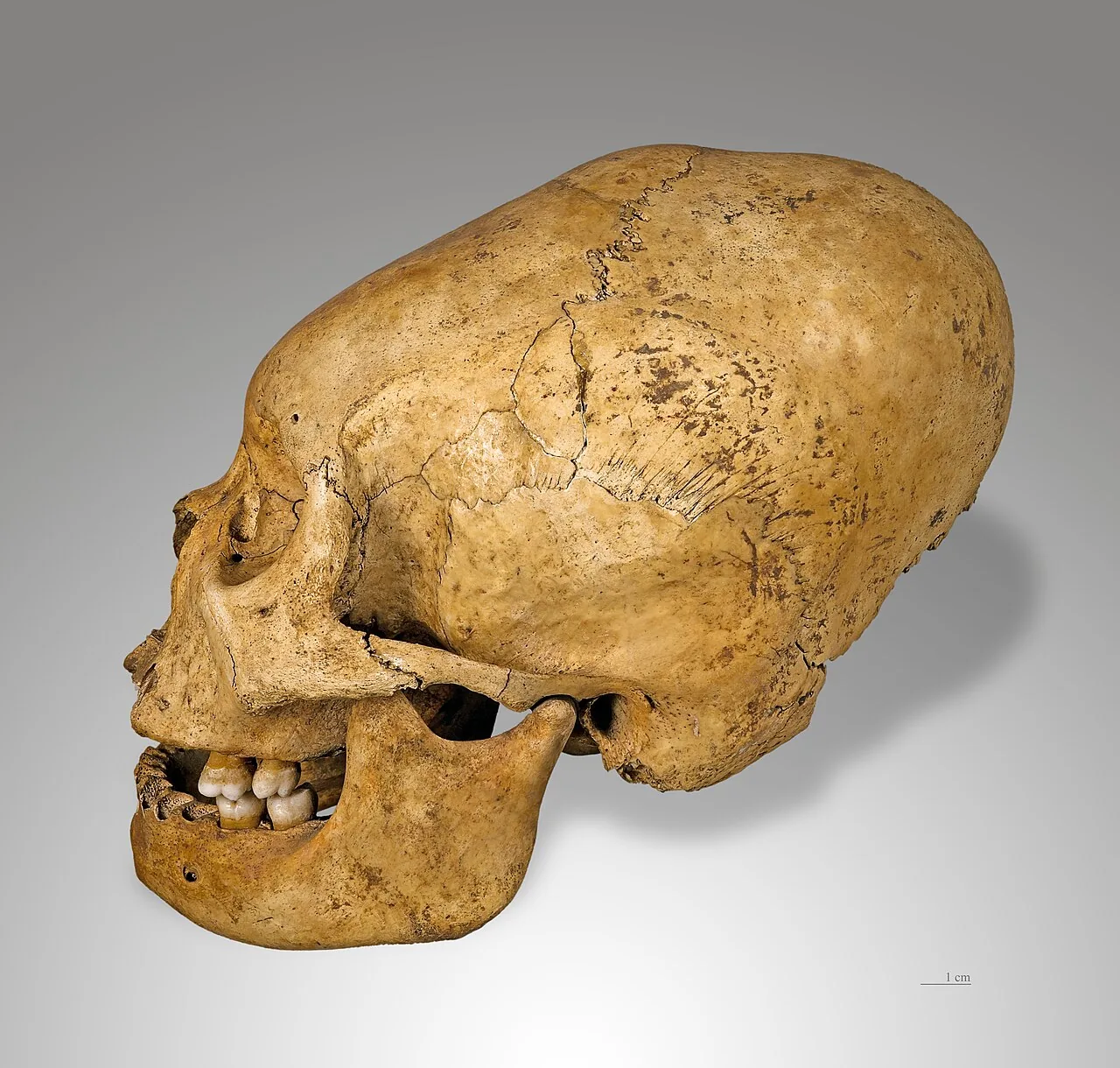
The skull claims fall the same way, and for an instructive reason: the anomalies are what binding itself produces.
Take the “one parietal plate.” The top of a normal skull is roofed by two parietal bones, joined along the sagittal suture, the seam that runs from front to back over the crown. A 1996 study of ancient Maya skulls from Lamanai in Belize found that binding the head front and back was “significantly associated with premature sagittal synostosis,” the early fusing of exactly that seam [17]. The author proposed that the apparatus pulls on the suture while the parietal bones are growing fastest [17]. A fused seam leaves two bones that look like one. Far from ruling binding out, a missing suture is one of the things binding is documented to cause.
Then capacity. A 2013 study scanned 39 deliberately shaped skulls and 19 unshaped ones by CT and measured the cavities inside. Deliberate shaping, the authors wrote, “can modify the shape of the cranial cavities and the thickness of their walls but conserve their volumes” [18]. The bioarchaeologist Matthew Velasco puts it simply: the brain is malleable, so binding changes the shape of the cavity, not the volume of the brain [19]. That is the same point Foerster’s doctors made to him in 2014 [10]. The 25 percent figure has never been published with a method we could find, and the peer-reviewed measurements run the other way.
Here the hard line sits. On one side are the binding devices in the graves, the 98 percent rate, the documented effects on sutures and the conserved volumes [7][8][17][18]. On the other are a capacity figure without a method, a suture claim that binding explains, and DNA results that were either never published or came back as named human lineages [9][4]. The long heads of Paracas were made by human hands.
That answer is solid. It also leaves the deeper puzzle fully standing.
Twelve Thousand Years of Long Heads
If you set the Paracas skulls aside and look at the practice itself, the record becomes stranger, not tamer.
Paracas was late. The earliest skulls with generally accepted signs of deliberate shaping date to around 13,000 to 10,000 years ago, in western Asia, in south-eastern Australia and in East Asia; in the Americas the practice began more than 8,000 years ago [20]. At Houtaomuga in north-east China, a team led by Quanchao Zhang and Qian Wang found 11 shaped skulls among 25 skeletons, from both sexes and ages from childhood to adulthood, spanning about 12,000 to 5,000 years ago [21][20]. In Australia, the anthropologist Arthur Durband compared Pleistocene skulls from Coobool Creek, Kow Swamp and Cohuna with a known head-shaping population from New Britain and found added support for the view that at least some Ice Age Australian groups shaped their children’s heads [22].
The oldest dates are disputed, and the dispute is worth stating fairly. The palaeoanthropologist Xijun Ni of the Chinese Academy of Sciences thinks the 12,000-year-old Houtaomuga skull was probably not deliberately shaped, and puts solid evidence at the site at about 6,000 years [20]. Wang disagrees, and the Russian archaeologist Maria Mednikova sides with him, describing “an entrenched tradition that continued for millennia” [20].
Even on the cautious reading, the practice spans many parts of the world and many thousands of years [20]. The method rests on one simple idea: pressure on the soft skull of an infant, by hands, boards or tightly wound cloth [20]. It survived into modern times. The Second Council of Lima banned it in Peru in 1567, and in France a form known as the Toulouse deformation was common enough in the nineteenth century to be outlawed by local decrees in the early twentieth [7].
The Houtaomuga team wrote the sentence that every honest account of this practice ends up needing: “Unfortunately, motivation of the act is unclear” [21]. Nor does anyone know how it spread. “It is too early to tell whether intentional cranial modification first emerged in East Asia and spread elsewhere or originated independently in different places,” Wang told Science News [20]. If it spread, he suggested, it may have moved west across the steppes and east over the Bering land bridge into the Americas [23].
The Mainstream Case at Full Strength
The mainstream explanation deserves its full weight, because it is good.
Shaping a baby’s head takes no special knowledge. Infant skull bones are soft, and hands, boards or tight wrappings reshape them [20]. Independent invention in many places is therefore entirely plausible [23]. Once discovered, a shape becomes a sign. At Paracas it seems to have marked gender and belonging [8][7]. In the Colca Valley, Velasco found the practice rising from 39.2 to 73.7 percent of burials during a time of upheaval, and suggests that a shared head shape may have strengthened ties between groups while deepening social differences [19]. At Houtaomuga it seems linked to high-status individuals or families [23][20]. Velasco reads Andean head shaping as a form of childcare, part of a rite of passage in which kin bestowed land and resources on a child, and thinks an ancient parent asked why might simply have said, “Because it’s beautiful” [2].
All of that fits the bones. Where it thins out is on origin. Identity explains why a shape mattered inside one society. It does not explain why, from the end of the last Ice Age onward, people on several continents chose this particular, effortful thing to do to their children, and the specialists themselves say the motive and the route are unresolved [21][20].
The Mountain in the Bone
This is where the Collaguas come back in.
Velasco treats their testimony with care. “I can’t say for sure that their 14th century ancestors held the same belief,” he says, though mountains are central to Andean thought past and present, and modern Andean ethnographies link children to mountains specifically [2]. In 2018, discussing the same colonial document, he put the stakes plainly: “If this is true, then cranial modification reflects a deeply religious worldview and was fundamental to a person’s being and existence” [19]. Their neighbours the Cavanas told the same magistrate that they too had come from a mountain, a snow-crowned peak called Gualcagualca, and that they bound their babies’ heads flat and wide [1].
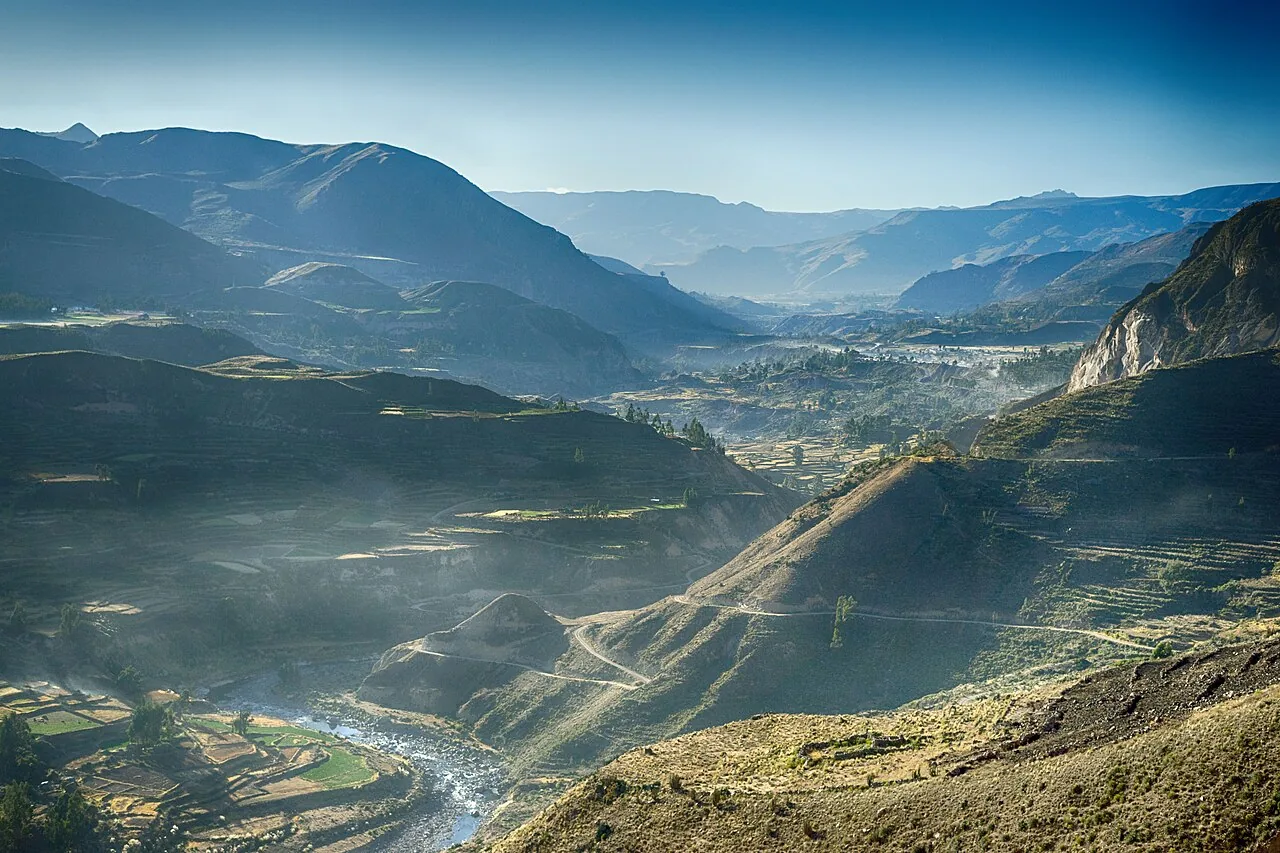
The record does not say that the Cavanas’ flat heads copied their mountain. It says that both peoples traced their origin to a peak, and that each shaped its children’s heads so differently that anyone could tell a Cavana from a Collagua by the head [1]. The Collagua testimony goes further. For them the head was not decoration. It was a copy of a place of origin, made on purpose in every child, so that a person carried the memory of where their people had come from in the shape of their own skull. Dausse reached a related conclusion at Paracas from the graves alone: the shaped head was symbolic because it was the seat of thought and communication, revealed when a person became an ancestor (our translation) [7].
Ancient Peru practised a second kind of head-craft. The country has yielded more prehistoric trepanned skulls, skulls deliberately opened by surgery, than anywhere else on Earth. A study of more than 800 of them found that long-term survival rose from about 40 percent in 400 to 200 BC to 91 percent between AD 1000 and 1400, while American Civil War cranial surgery killed 46 to 56 percent of patients [24]. The authors called it “the astonishing success of ancient cranial surgery in Peru in the treatment of living patients” [24]. In ancient Peru the human head was something people shaped, opened and, in time, healed with a success later surgeons would envy.
What They Were Remembering
Here is a guess, and it is only a guess. If the Collaguas’ reason is old, and not a late gloss on an older habit, then head shaping may often have been a kind of memorial: a likeness of something a people believed they came from, renewed in the body of every child. The Collaguas pointed to a mountain. Nobody knows what the first shapers, more than ten thousand years ago, were pointing to, or whether the ones at Houtaomuga, Coobool Creek and Paracas were remembering the same thing. Nobody has tested it, and the bones alone may never say.
What would move the question forward is known. Authenticated ancient DNA from Paracas Cavernas skulls, taken in a dedicated laboratory, replicated independently and published, would settle the DNA question properly [14][13]. Direct radiocarbon dates on the oldest shaped skulls would help settle how early the practice began [20]. A careful comparison of shaping methods from region to region could show whether one tradition travelled or many began [23]. These suggestions are ours.
Until then, the skulls in the museum at Ica keep their small drilled holes beside the spinal opening, and the answer they gave was human. The older question is still unanswered, and it was put most clearly in 1586 by people with long heads, sitting before a Spanish scribe: they bound their children’s heads in memory, so that each would carry the high form of the mountain their ancestors came out of [1].
Sources
- "Relación de la provincia de los Collaguas" (Yanqui Collagua, 20 January 1586; corregidor Juan de Ulloa Mogollón), in Relaciones geográficas de Indias: Perú, vol. 2 (Madrid, 1885), pp. 38–41. https://archive.org/details/b24871771_0002
- James Dean, "Mountains embodied: understanding head shaping in ancient Andes," Cornell Chronicle, 15 August 2025. https://news.cornell.edu/stories/2025/08/mountains-embodied-understanding-head-shaping-ancient-andes
- Ministerio de Cultura del Perú, Dirección General de Museos, Resolución Directoral N° 000032-2016/DGM/VMPCIC/MC, 15 September 2016. Via https://museos.cultura.pe/node/810
- Rubén García Soto, Proyecto de investigación arqueogenético de cráneos Paracas Cavernas y Paracas Necrópolis: Informe final (Lima, March 2018), filed with Peru's Ministry of Culture. Via https://museos.cultura.pe/node/810
- MedlinePlus Genetics, U.S. National Library of Medicine, "Mitochondrial DNA" and "What is genetic ancestry testing?" https://medlineplus.gov/genetics/chromosome/mitochondrial-dna/ ; https://medlineplus.gov/genetics/understanding/dtcgenetictesting/ancestrytesting/
- Christina De León, "Paracas Mummy Bundles," Bard Graduate Center, 2017. https://www.bgc.bard.edu/research/articles/358/paracas-mummy-bundles
- Claude Bouchonnet, interview with Lucie Dausse, "Les déformations crâniennes paracas : une marque d'identité imprimée sur l'os," Archéologie des Amériques (UMR 8096, CNRS), 2016. https://archam.cnrs.fr/les-deformations-craniennes-paracas-une-marque-didentite-imprimee-sur-los/
- J. Gómez-Mejía, D. Aponte, L. Pezo-Lanfranco, S. Eggers, "Intentional cranial modification as a marker of identity in Paracas Cavernas," Journal of Archaeological Science: Reports 41 (2022): 103264 (abstract). https://portalrecerca.uab.cat/en/publications/intentional-cranial-modification-as-a-marker-of-identity-in-parac/
- April Holloway, "Initial DNA analysis of Paracas elongated skull released, with incredible results," Ancient Origins, 5 February 2014 (claimant source). https://www.ancient-origins.net/news-evolution-human-origins/initial-dna-analysis-paracas-elongated-skull-released-incredible
- April Holloway, interview transcript with Brien Foerster, Ancient Origins, 8 February 2014 (claimant source). https://www.ancient-origins.net/news-evolution-human-origins/initial-dna-analysis-paracas-transcript-399284
- M. van Oven and M. Kayser, PhyloTree mtDNA tree, Build 17 (2016). https://www.phylotree.org/tree/index.htm
- Ministerio de Cultura del Perú, Resolución Directoral N° 900006-2018/DGM/VMPCIC/MC, 25 May 2018. Via https://museos.cultura.pe/node/810
- L. Fehren-Schmitz et al., "Climate change underlies global demographic, genetic, and cultural transitions in pre-Columbian southern Peru," PNAS 111, no. 26 (2014): 9443–48. https://doi.org/10.1073/pnas.1403466111
- B. Llamas et al., "From the field to the laboratory: Controlling DNA contamination in human ancient DNA research in the high-throughput sequencing era," STAR: Science & Technology of Archaeological Research 3, no. 1 (2017): 1–14. https://doi.org/10.1080/20548923.2016.1258824
- L. Fehren-Schmitz et al., "Pre-Columbian population dynamics in coastal southern Peru: A diachronic investigation of mtDNA patterns in the Palpa region by ancient DNA analysis," American Journal of Physical Anthropology 141, no. 2 (2010): 208–21 (abstract). https://pubmed.ncbi.nlm.nih.gov/19639639/
- A. R. McDowell, B. M. Heinz, K. N. Mossé, "DNA Extraction from Ancient Conehead Mummy Teeth," Liberty University Research Week poster, 2026 (not peer reviewed). https://digitalcommons.liberty.edu/cgi/viewcontent.cgi?article=2856&context=research_symp
- C. D. White, "Sutural effects of fronto-occipital cranial modification," American Journal of Physical Anthropology 100, no. 3 (1996): 397–410 (abstract). https://pubmed.ncbi.nlm.nih.gov/8798996/
- R. H. Khonsari et al., "Shape and volume of craniofacial cavities in intentional skull deformations," American Journal of Physical Anthropology 151, no. 1 (2013): 110–19 (abstract). https://pubmed.ncbi.nlm.nih.gov/23553676/
- Linda B. Glaser, "Infant skull binding shaped identity, inequality in ancient Andes," Cornell University, College of Arts and Sciences, 2018. https://archaeology.cornell.edu/news/infant-skull-binding-shaped-identity-inequality-ancient-andes
- Bruce Bower, "East Asians may have been reshaping their skulls 12,000 years ago," Science News, 2019. https://www.sciencenews.org/article/east-asians-may-have-been-reshaping-their-skulls-12000-years-ago
- Q. Zhang et al., "Intentional cranial modification from the Houtaomuga Site in Jilin, China," American Journal of Physical Anthropology 169, no. 4 (2019): 747–56 (abstract). https://pubmed.ncbi.nlm.nih.gov/31237364/
- A. C. Durband, Journal of Human Evolution 54, no. 6 (2008): 795–813, and American Journal of Physical Anthropology 155, no. 1 (2014): 173–78 (abstracts). https://pubmed.ncbi.nlm.nih.gov/18243276/ ; https://pubmed.ncbi.nlm.nih.gov/24964764/
- Texas A&M University, "Texas A&M Dentistry Professor's Discovery Points To Evidence Of Skull Shaping," 16 July 2019. https://stories.tamu.edu/news/2019/07/16/texas-am-dentistry-professors-discovery-points-to-evidence-of-skull-shaping/
- D. S. Kushner, J. W. Verano, A. R. Titelbaum, "Trepanation Procedures/Outcomes: Comparison of Prehistoric Peru with Other Ancient, Medieval, and American Civil War Cranial Surgery," World Neurosurgery 114 (2018): 245–51 (abstract). https://pubmed.ncbi.nlm.nih.gov/29604358/
Translations from Spanish and French are ours. For sources marked "abstract," only the published abstract was read.
Not opened (named only through other sources): Velasco's 2018 Current Anthropology article and his 2025 book The Mountain Embodied; Tello 1959; Tello and Mejía 1979; Wallace 1971; Weiss 1962; full texts of sources 8, 15, 17, 18, 21, 22 and 24. No peer-reviewed publication of the 2014 Foerster result or of the García 2018 results was found.
Images are photographs by Marcin Tlustochowicz (CC BY 2.0), Didier Descouens (CC BY-SA 3.0) and Tydence Davis (CC BY 2.0), via Wikimedia Commons, credited and licensed in each caption; they were resized only, none is AI-generated, and no labels or overlays were added. The video is included for viewing and is not cited as a source. Inferences and speculation are labelled as ours in the text.