It is sixty-one centimetres across, older than the pyramids, and worked in stone into a shape with no known twin 178. Five thousand years on, nobody can say what it was for, and we could find no published measurement of how thick it is.
Go ahead. Drag it round, look underneath, then come back.
A wheel in a robbed room
In January 1936 the British archaeologist Walter Emery was clearing Tomb 3111 at North Saqqara, on the desert edge about 1.7 kilometres north of the Step Pyramid 1. Its owner was a man named Sabu. He was no prince. Jar sealings in the tomb carry the names of two First Dynasty kings, Den and Anedjib, and Sabu seems to have served them as a high official, perhaps over a town or province possibly called "Star of the family of Horus" 1.
Robbers had been there first, at some point in its long history 1. Even so, Sabu still lay where he had been placed, on his right side, slightly flexed, head to the north 1. Around him were copper and flint tools, ivory boxes, arrows, the bones of two oxen, and 48 stone vessels, most of them smashed 1.
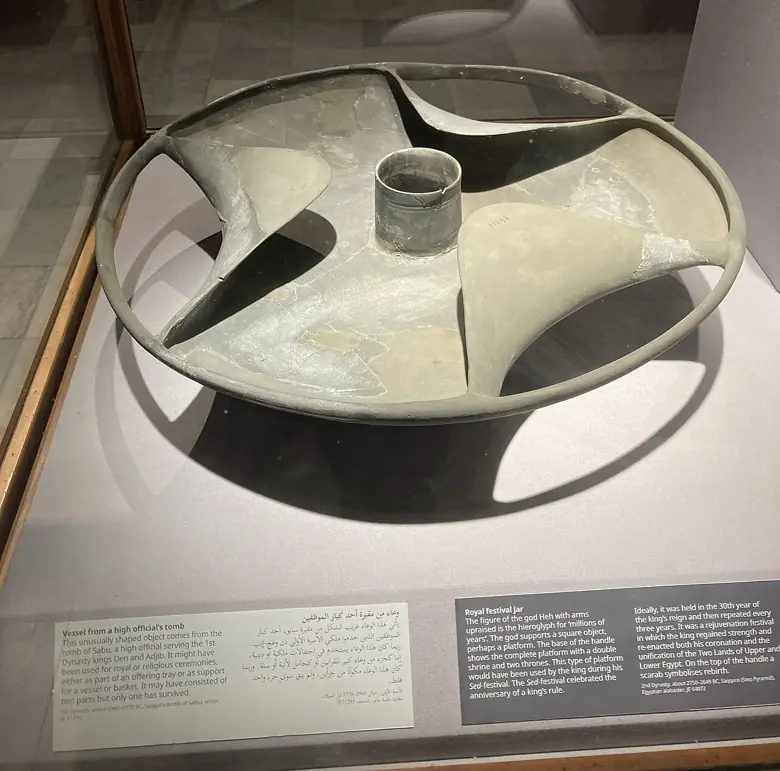
One of those vessels had been crushed and scattered around the centre of the tomb 1. When restorers glued the pieces back together, they made the object you just turned 14.
What you are holding
Picture a shallow stone dish about the width of a car tyre. Emery recorded a maximum diameter of 61 centimetres and a height of about 10 1; a 2026 paper by Rostislav Lapshin of Moscow's Kurchatov Institute gives 10.6 4. Lay two vinyl LPs side by side and you are close to its span (our comparison; tap or click the Scale toggle).
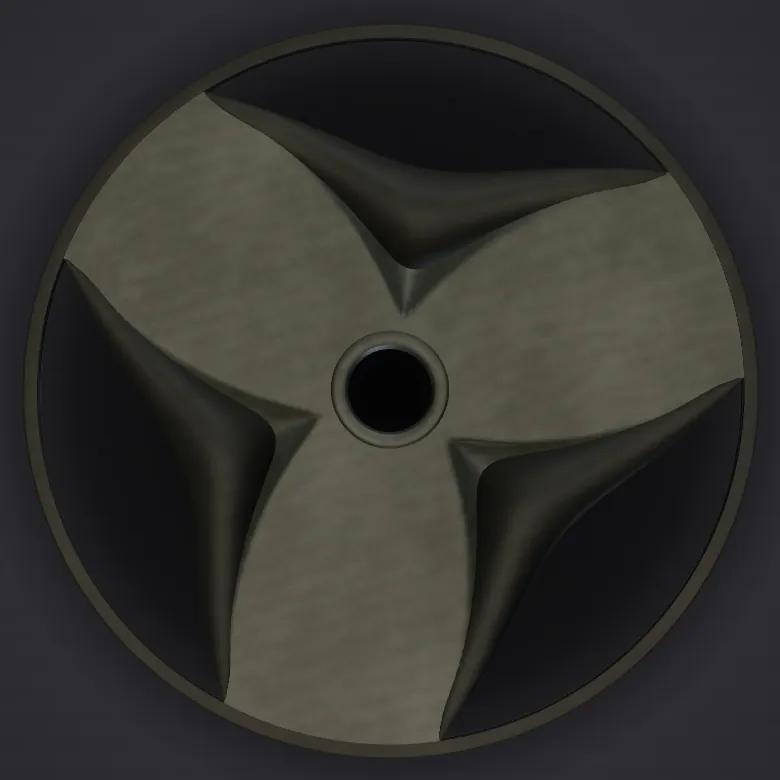
Three thin lobes sit at 120 degrees around the rim, each one folded inward and curling toward the centre 110. Between each lobe and the rim is a lens-shaped opening cut right through 1. In the middle rises a hollow stone tube. Hall of Maat gives it as about 10 centimetres across; Lapshin gives the hole inside it as about 8 14. On the CC0 redraw of Emery's plan, the hole sits inside a raised collar, which may be why the figures differ (our reading of the drawing) 10.
Now tap or click Edge-on. Seen from the side, the real bowl is not perfectly symmetrical; a photograph in the Hall of Maat study shows the profile wandering 1. Keep that in mind the next time you read a claim about its precision.
Older books call the stone schist or slate. The geology says otherwise: it is metasiltstone, a siltstone altered by heat and pressure just enough to harden it 1. That matters. Slate splits into sheets. Metasiltstone does not fracture easily along planes, and it holds fine detail, which is why Early Dynastic carvers used it for some of their most intricate pieces 1.
A century in love with stone
Sabu lived in a culture with something close to an obsession. In the galleries beneath Djoser's Step Pyramid, built some three centuries after him, excavators recovered roughly 40,000 stone vessels, some inscribed with the names of First and Second Dynasty kings 67.
The same carvers did something stranger, and it is the key to this object. They kept remaking other materials in stone. There are Early Dynastic stone vessels shaped like leaves, carved to look like basketwork, and one that copies a metal pot down to imitation rivet heads 1. Tombs like Sabu's did it too: early First Dynasty mastaba fronts were plastered and painted to imitate wood and woven reed mats 1. Djoser's complex then did it at the scale of architecture, in stone forms that mimic structures once built of mud brick and other perishable materials 7.
Hold that habit in mind. It is about to matter.
The best ordinary answer
The mainstream case is strong, and it deserves to be heard at full strength.
Emery suggested the disk imitated the form of a metal vessel, and that the central hole was meant to sit on a pedestal 1. Stone tubes were used throughout Egyptian history as stands for round-bottomed pots 1. Because the lobes are so delicate, the Hall of Maat study concludes the piece was most likely ornamental, made for religion or ritual rather than use 1. It even offers a precedent for the layout: a clay figurine from the earlier Naqada II period, now in London's Petrie Museum, with three raised snakes set at 120 degrees around a central vessel 1. The same study walks through a plausible way to carve it with copper chisels, stone grinders, sand and patience, and notes that copper chisels are known to work on this stone 1.
On this reading, the Sabu Disk is a masterpiece from a century of masterpieces. Superb, and entirely human.
Four stories, tested
Vessel on a stand. Tap or click the card and a pole slides into the 3D disk. It fits, and stone tube stands are well known 1. But none of the sources we opened records a stand from the tomb, which had been ransacked, so the idea can't be checked against the find 1.
A lamp, or a fire bowl. William Kay proposed a three-flame oil lamp, with bundles of rushes soaked in oil held by the lobes 1. In 2017 and 2018 a team at Airbus in Hamburg tested copies for the German broadcaster ZDF 23. Their lead, Peter Sander, head of emerging technologies, poured paraffin into a metal version and lit it. The inner lobes stirred the air so that the flames danced, and from an engineer's point of view a ceremonial fire bowl was the likeliest answer 2.
A stone copy of a metal object. Tap or click to switch the 3D material to copper. Now the shape looks easy: beaten sheet, folded lobes. This is the reading Emery leaned toward 1, and it fits that Early Dynastic habit of copying other materials in stone 17.
A machine part. This is the claim that made the disk famous online, though no published evidence backs it; ZDF's own programme text notes it had even been identified as a possible spaceship drive 3. The Airbus team put a full-size copy in a wind tunnel. It produced lift, but it was useless as a propeller or turbine. The central shaft was too out-of-round and too weak to carry power 2. Sander's verdict, in his words to the Berliner Morgenpost: "Da dreht sich leider nichts," roughly "sadly, nothing turns" 2.
So the rotor fails. Good. That clears the table for the question the rotor was hiding.
The measurements nobody has published
Here is what is strange. This is one of the most debated objects from early Egypt, and the basic numbers are missing.
No wall or lobe thickness has been published in any source we could find. No weight either. The Hall of Maat study put it plainly in 2003: "No detailed examination of its surface has been published in the archeological literature" 1. In his 2026 paper, Lapshin wrote that he could not find a single photograph of the disk's underside, and urged photographs from all sides, a 3D scan and X-ray CT 4. A May 2026 preprint by Khalid Saqr is titled "Seven Open Questions Concerning the Disk of Sabu c. 3000 B.C."; it has not been peer reviewed 5.
Then there is the restoration. The disk was found crushed 1. How much of the curl you see is original stone, and how much is the restorers' judgment, has not, as far as we could find, been set out in public. Lapshin claims the lobe tips were rebuilt; he gives no documentation for it, so treat it as his claim 4.
Slice it. That hooked profile is the whole case, and it is drawn, not measured.
A shape remembering something
The Airbus engineers had one more finding. Bionics researchers from the University of Bremen noticed the disk looks like a giant diatom, a single-celled alga with a glass shell 2. Sander pointed out the problem at once: diatoms are about a tenth of a millimetre across, invisible without a microscope 2. A resemblance proves nothing. It is still an odd thing to sit with.
Step back and look at what the evidence actually shows. The rotor reading fails the test. The ornament reading explains the care, and the snake figurine gives the layout a pedigree, but neither says why the lobes hook the way they do. The best mainstream answer, a stone copy of a metal object, is the one that points furthest: the culture that made it really did translate other materials into stone 17, and the use the Airbus engineers rated likeliest, the dancing fire bowl, was demonstrated in metal 2. None of the sources we opened names the metal original it would be copying.
So here is the question, and it is only a question. If a carver around 3000 BC took the trouble to reproduce in stone a form whose one demonstrated use was shown in another material, what was he looking at? Was it a vessel that has simply not survived? Or something else, an object important enough that a high official took its likeness into the dark with him?
The disk sits in the Egyptian Museum in Cairo, inventory JE 71295 1. Somebody could weigh it tomorrow.