
Scholarly
Inca Architecture and Construction at Ollantaytambo
Jean-Pierre Protzen · 1993
By the Berkeley architect behind the hammerstone experiments in this article, at full length on Inca stonework.
 THE NOMMO Where the evidence leads, we follow.
Articles · Andes · Sacsayhuamán
The method taught as the answer to Sacsayhuamán, hammerstones and patient trial fitting, is real and well demonstrated. But every demonstration so far used stones from over a hundred to about 2,500 times smaller than the wall’s giants, mostly in a different rock, and nobody has measured the joints more than about five centimetres deep. The walls are limestone, the earthquake-proof story is mostly assumption, and the builders left no account of how they did it.
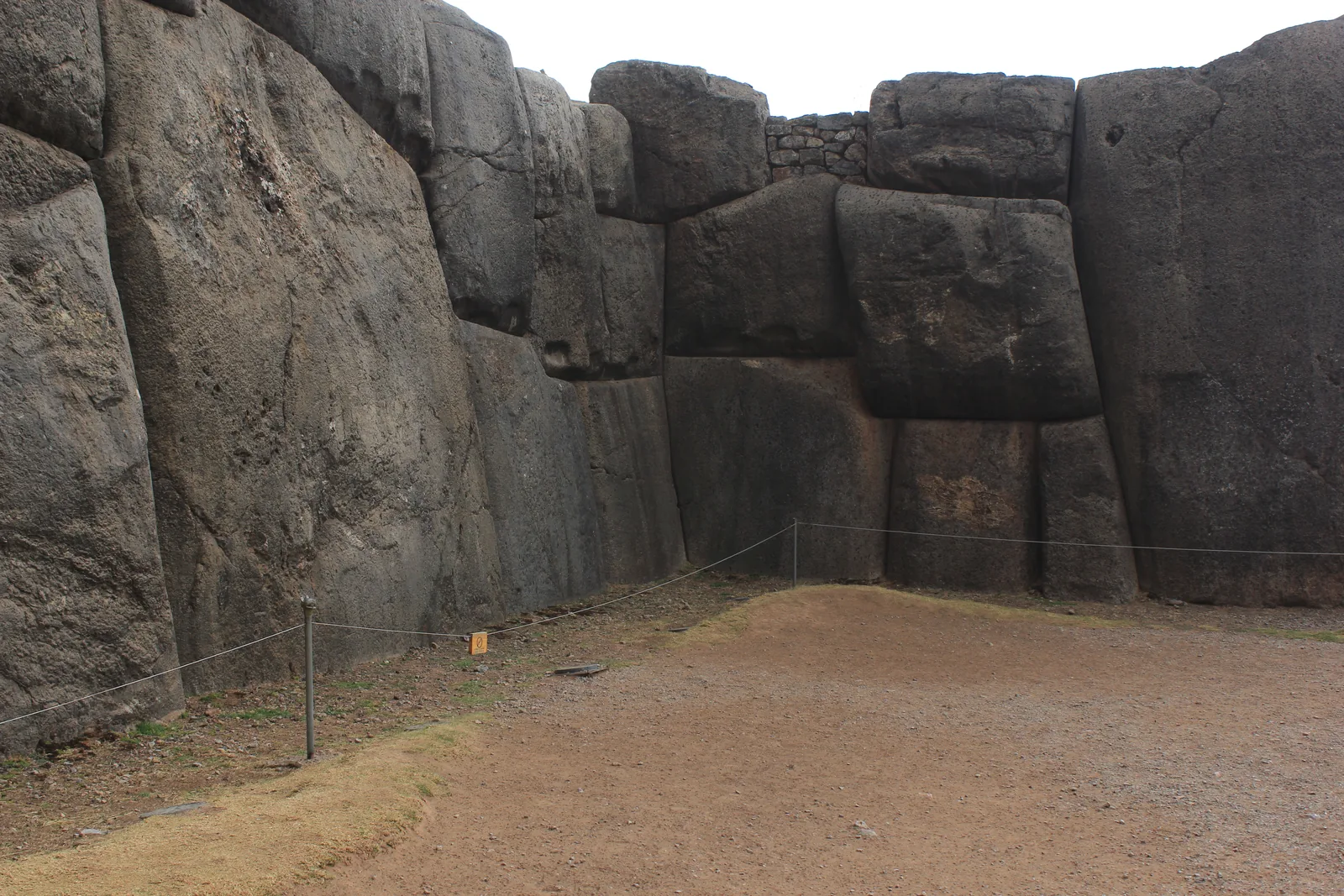
In the early 1980s an architect from the University of California, Berkeley, set out to read two walls at Sacsayhuamán, the great terraced complex on the hill above Cusco, Peru. Jean-Pierre Protzen wanted the angles at which each giant stone met its neighbours, because those angles would tell him the order in which the stones had gone in. He could not get them. The fit, he wrote, “does not allow one to introduce even a knife blade into the joints.” Where he did manage to measure, it was often only to a depth of about five centimetres, and even that much worried him, because the faces where the stones meet “quite frequently are not flat but warped.” What happened deeper inside the wall, he could not say.[1]
Those lines sit in the paper that became the standard answer to how the Inca built. The paper’s method is famous. The paragraph about what its author could not see is much less so. Follow that paragraph, and one of the most retold stories in Andean archaeology turns out to have an unfinished chapter: the part where anyone shows that the answer works at the size of the stones it is meant to explain.
The basic story of the site, its zigzag walls, the conquest and the legends is told on the Sacsayhuamán record page. This piece stays with the stones, and with the evidence that has to be looked at sideways to be seen at all.
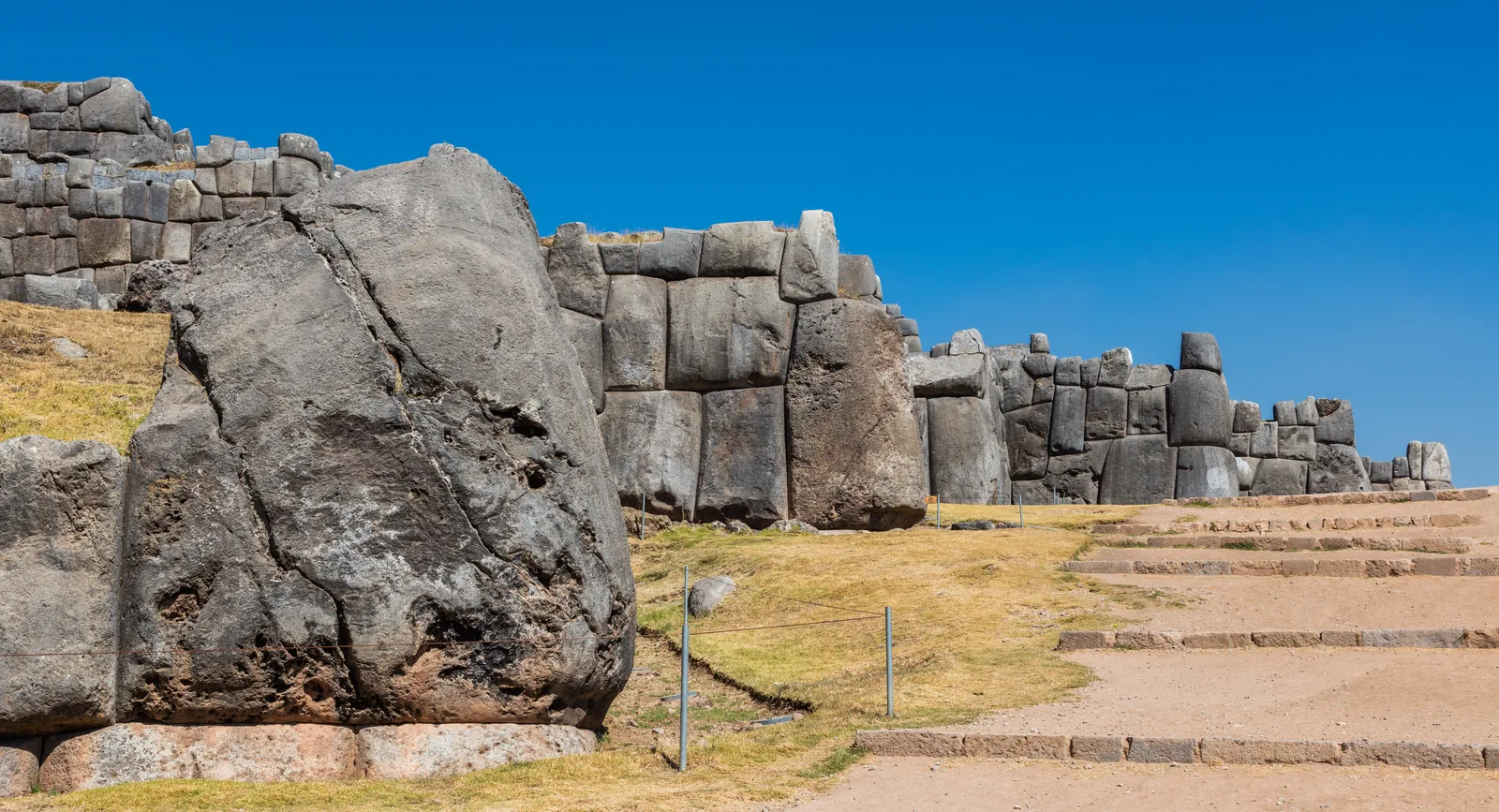
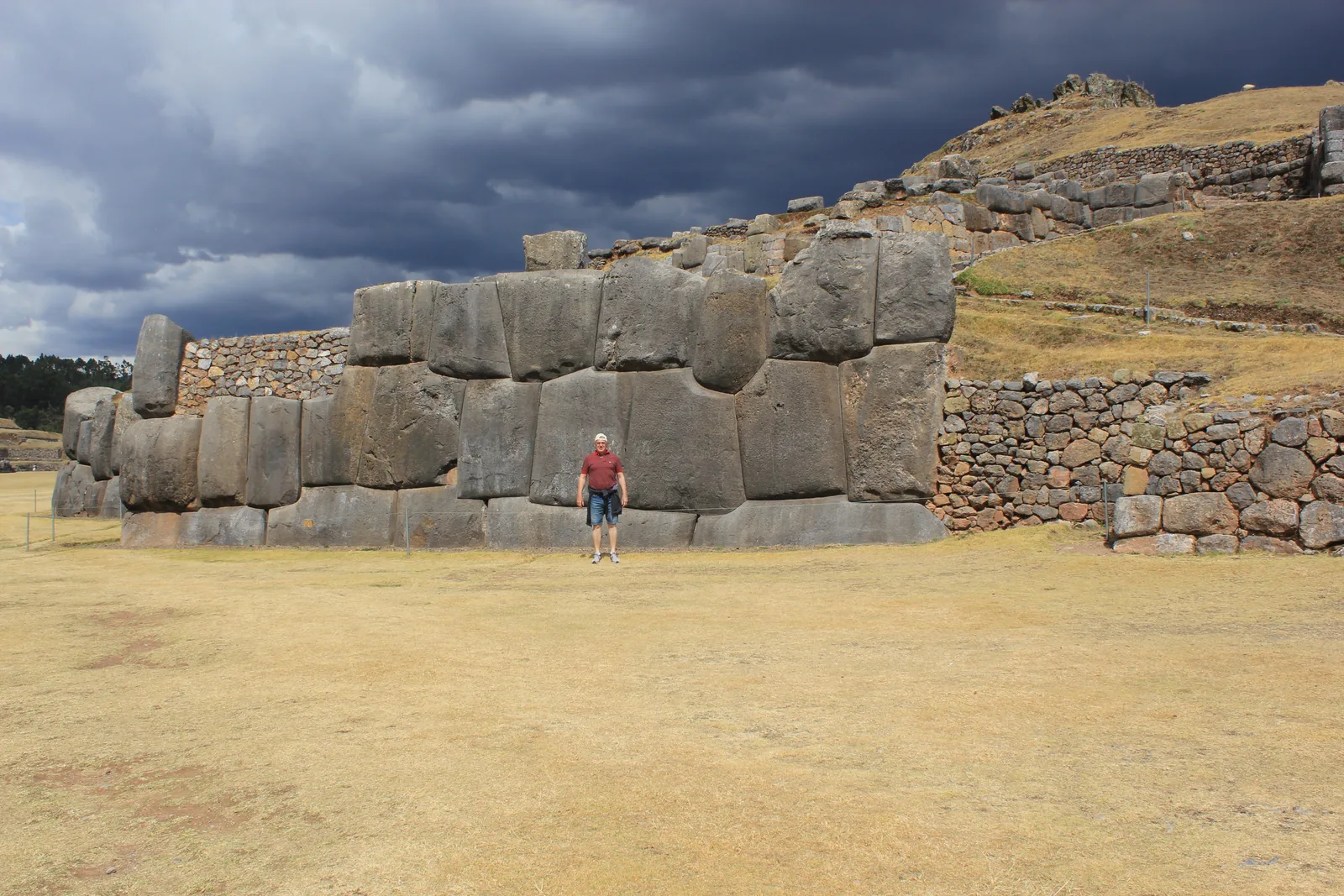
Sacsayhuamán’s north side is closed by three stacked terraces, each held up by a zigzagging retaining wall of enormous many-sided stones.[10] Peru’s official tourism inventory says the stones of the main wall reach 5 metres high and 2.5 metres wide and may weigh between 90 and 125 tonnes.[10] A geology team presenting at the Geological Society of America in 2012 wrote that some blocks are “over 125 tonnes.”[9] Gordon McEwan, writing in a scholarly encyclopedia of Latin American history, put it more cautiously: some stones “have been calculated to weigh as much as 60 tons.”[14] The bigger figures that circulate, up to 200 or even 300 tonnes, I could not trace to anyone who weighed or measured a stone.[15]
There is a simple reason the numbers wander. A visitor sees one face of each block. Nobody sees how far it runs back into the hill.
Here is a calculation that shows why that matters, so anyone can check it. The Victorian scholar Clements Markham, in a footnote to his 1871 translation of Garcilaso, gave his own measurement of a great stone at the eleventh salient angle of the outer wall, counting from the west: fourteen feet high by twelve across, about 4.3 by 3.7 metres.[3] The rock of these walls is almost pure limestone, which weighs up to about 2.75 tonnes per cubic metre.[9][16] Taking 2.6 to 2.7 tonnes, that one face gives about 41 tonnes if the stone is a metre deep, about 82 tonnes at two metres, and about 124 tonnes at three. Every estimate in the paragraph above could fit a face of that size. The only thing that changes is a dimension no one can see.
The stone type is the first thing popular accounts get wrong, and the error matters more than it looks. Sacsayhuamán’s giants are often called andesite, a hard grey volcanic rock. The 2012 team crushed samples of the walls and ran them through X-ray diffraction, a method that identifies minerals by how their crystals scatter X-rays. Fresh rock came out at 94.7 per cent calcite, the mineral that makes limestone.[9] A 2022 doctoral survey of Inca walls around Cusco likewise describes the few cyclopean walls as retaining walls “using limestone blocks.”[4] A German stone expert who studied the site, Christian Singewald, adds that the same limestone crops out on the spot and about a kilometre east at Qenqo, while diorite, a speckled igneous rock, breaks through only around the carved outcrop called the Inca’s throne.[15]
Andesite belongs to a different story. It came from the quarries of Rumiqolqa, 35 kilometres southeast of Cusco, which supplied much of the andesite used to build the city below.[1] And Rumiqolqa is where the most famous experiment in Inca archaeology was done. The block Protzen dressed by hand during his 1982 fieldwork was andesite, not limestone.[1]
In fairness, that difference cuts in the mainstream’s favour. Calcite rates 3 on the Mohs scale of mineral hardness; a steel knife rates 5.5.[17] Protzen’s hammerstones were at least 5.5, “comparable to the hardness of the andesite.”[1] Limestone should be easier to pound than the rock he tested, and he found the same pit marks on Inca walls of every rock type, on limestone as small whitish spots where the heat of each blow had altered the stone.[1]
If the stone grew on the hill itself, as Singewald suggests, much of the hauling problem may also shrink.[15] Garcilaso de la Vega, who grew up in Cusco and wrote in Spain in 1609, said the opposite, that many stones were dragged from ten to fifteen leagues away and the nearest from five.[3] He was writing far from Cusco, partly from reports sent by old schoolfellows, and he complained that their measurements were not as precise as he wanted.[3] The rock samples are the better witness.
So the giants are softer than the textbook stone, and perhaps closer to home. What they are not is the thing that was tested.
Protzen’s work deserves to be stated at its strongest, because it is very good. In one Inca quarry pit at Rumiqolqa, the Llama Pit, he mapped 68 stone tools: river cobbles of quartzite, sandstone, granite and basalt, foreign to the quarry, lying among the andesite chips.[1] They weighed from a couple of hundred grams to 8 kilograms.[1] He picked one of about 4 kilograms and found the trick of it. Let the hammer fall, catch it on the rebound, and strike at a slight angle so that each blow shears off tiny flakes instead of merely crushing.[1]
One face of a raw block took him twenty minutes. Three faces and five edges took no more than ninety.[1] His test block measured about 25 by 25 by 30 centimetres.[1]
He solved a small aesthetic puzzle on the way. On 31 Inca blocks the angle between neighbouring faces averaged 117 degrees, not 90.[1] That bevel is what drafting an edge with a small hammer naturally leaves behind, and it produces the sunken joints whose shadows make Inca walls look quilted.[1]
Then the fit. Protzen noticed a rule: each new course’s bed is cut into the top of the course already laid, with only occasional exceptions, and where walls have been taken apart the cuts are still visible.[1] That finding killed the old idea that stones were ground against each other until they matched.[1] He traced the outline of an upper stone onto a lower one, pounded out the seat, set the stone down, and looked at the dust. Where the dust was squeezed flat, the stones touched, and he pounded there again.[1] “Through repeated fitting and pounding,” he wrote, “one can achieve a fit as close as one wishes.”[1]
The Jesuit José de Acosta, quoted by Garcilaso, had reached the same conclusion: to fit one stone to another, “it must have been necessary to try it many times.”[3] Garcilaso himself recorded that the masons dressed stone with black stones, “pounding rather than cutting.”[1]
In 1986 the architect Vincent Lee proposed a different route borrowed from log-cabin builders. Hold the upper stone just above its place, copy its underside onto the stones below with a scribe, a compass-like marking tool, cut the seat to the line, and lower the stone once.[2] When the American public-television series NOVA brought both men to Peru in 1997, Protzen finished a hand-fitted joint “within a few hours,” and 250 people from Ollantaytambo and nearby villages dragged a genuine fifteen-ton Inca block over a sloping cobbled surface.[13] In the same year Protzen and Stella Nair compared Inca masonry with the older stonework of Tiwanaku, in Bolivia, found fundamental differences, and concluded that “the ingenuity of Inca masonry originated with the Incas.”[12]
Tools found, marks matched, two colonial writers in agreement, a working joint, a moving block. That is a serious case.
Now line the demonstrations up by size.
Protzen’s dressed block was about the volume of a large household bucket, under 19 litres. A 125-tonne limestone block would hold roughly 2,500 times its volume. The scribing trial filmed for NOVA was done on what the narrator called “a half-ton rock.”[13] The heaviest stone handled on camera, the fifteen-tonne block, was dragged, not lifted, cut or fitted.[13] Between that and the estimates for the walls there is a gap of somewhere between four and eight times in weight, and for fitting, a gap of a hundred times or more.
The men who built the ladder knew where it stopped. Protzen wrote in 1983: “I concede that this technique appears to be tedious and laborious, especially if one thinks of the cyclopean blocks at Saqsawaman or Ollantaytambo.”[1] His answer was that time and labour were probably of little concern to the Inca and that a practised eye would cut the number of trials.[1] That is reasonable. It is also a judgement, not a test.
Of moving and lifting the stones, Protzen said plainly that he had not taken the subject up, beyond a suspicion that earthen ramps were used.[1] The order in which the giants were set, he added, could only be settled “after careful motion studies have been conducted.”[1]
Lee was blunter. At the time he wrote, “no studies have yet been published suggesting precisely how a trial and error system might have worked on such large stones.”[2] Of his own method he wrote that the evidence “is almost entirely circumstantial, and falls well short of proof positive.”[2] He named the experiment that would count: “to attempt to duplicate the work found at Sacsahuaman today,” adding that even success might not settle the issue.[2] On camera in 1997, asked whether they had shown how it was done, he answered: “I’m not sure we’ll ever know how the Incas did it.”[13]
I have not found that experiment in any source I opened, from 1983 to 2024. The textbook account of Sacsayhuamán is an extrapolation from a bucket-sized block and a half-tonne rock to stones heavier than a loaded truck. It may be right. It has not been shown.
The second gap is geometry, and it is subtler.
A fair-minded skeptic will say the fit is partly an illusion. There is good evidence for that. Acosta wrote that the Inca dressed each rock only “where they join each other… for a width of four fingers.”[3] Protzen found that the side joints were often fitted only a few centimetres deep, with rubble behind.[1] Lee saw the insides of some Sacsayhuamán joints “slightly overcut,” so that only the visible edges touch, as log builders do to stop hidden high spots spoiling the fit.[2]
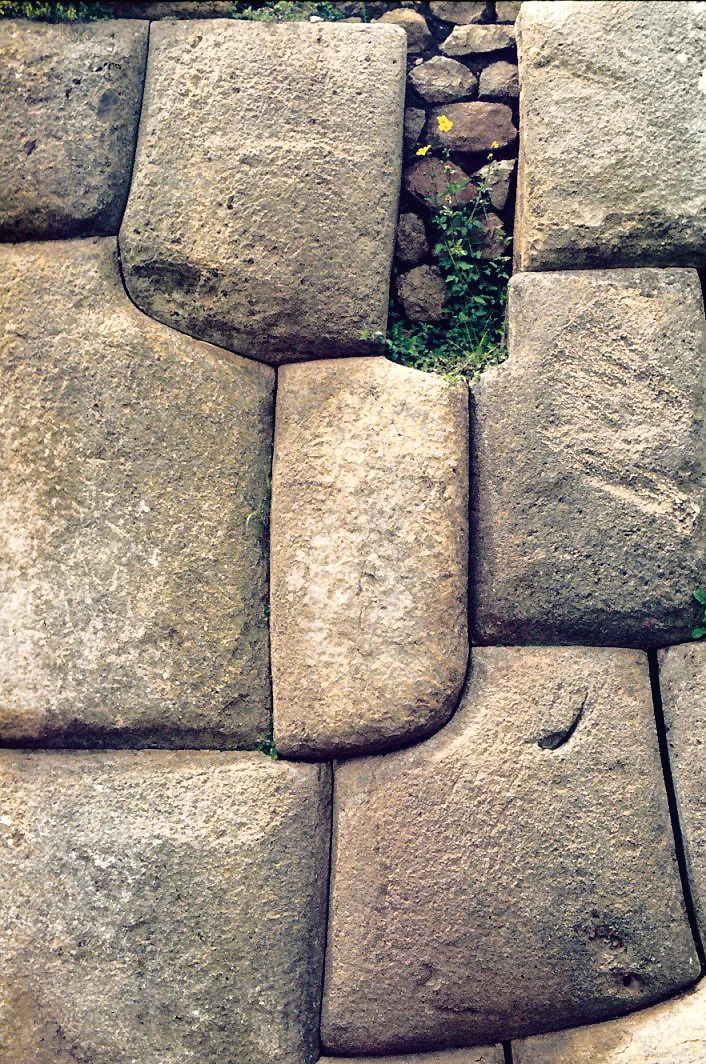
But the skin theory only goes so far. Protzen added that shallow fitting “rarely applies to bedding joints,” the joints that carry most of a stone’s weight down to the course below, and is “by no means the rule” even for the side joints, many of which were fitted “with the same care over the entire joining plane.”[1] And those planes are where his knife stopped: warped surfaces, curving in three dimensions, cut into stones that were already in place.[1] Lee photographed one open joint at Sacsayhuamán to show the warped plane along which the two stones had originally met.[2]
That shape is what makes the cost climb. Under trial and error, every check means lifting a stone of tens of tonnes off its seat, finding where the dust is pressed, and lowering it again. Garcilaso assumed exactly that: “It must have been necessary to raise and lower the stones a great number of times.”[3] Lee judged it “a horrendously tedious and inefficient process” for large stones, because each trial loses the reference point of the last.[2]
Lee’s alternative holds the giant still on timber props while masons work underneath it. On NOVA, after the half-tonne trial, the anthropologist Ed Franquemont said that “with a bigger stone, I think it would be more dangerous and more hard, and I still have my doubts.” The narrator asked the obvious question: what would it be like with a twenty-five-ton boulder?[13]
Protzen found one more detail in the walls he surveyed. Each course seemed to have its keystone, a wedge-shaped block set last, and a tapering gap in the second rampart showed that at least one had gone in from the front, perhaps, he suspected, off an earthen ramp.[1] He offered these sequences as tentative. If he read them right, somebody planned the order in advance, on stones far too heavy to correct casually. No one wrote the plan down.
If there is one thing everyone believes about these walls, it is that they were built to beat earthquakes, the blocks rocking in a tremor and settling back into place. The best recent work says the belief is mostly assumption.
Andy Combey’s 2022 doctoral study of Inca walls around Cusco, carried out with Peru’s geological institute, INGEMMET, observes that scholars “quickly hypothesized” the polygonal walls were earthquake-resistant and that “this assumption remains very common in scientific publications although very few works addressed the topic properly.”[4] He grants that the features probably helped the best buildings last, but finds “no evidence” that they were a deliberate design for that purpose.[4] His team then went looking for earthquake damage. Along about 1.5 kilometres of surveyed wall at Sacsayhuamán they logged 82 broken, downward-dipping corners and 96 displaced blocks.[4] The walls have been shaken, and they show it.
The numbers hold a twist. Normalised per 100 metres of wall, my own sum from the thesis tables, Sacsayhuamán shows about 5 broken corners against about 18 on the Inca walls in town, but about 6 displaced blocks against 2. The giants chip less and shift more. Combey warns that the city sits on a sedimentary basin that amplifies shaking and that the damage cannot yet be pinned to one earthquake, so this is a pattern, not a verdict.[4]
The engineering models agree with each other only loosely. Klaus-G. Hinzen and Arnaud Montabert found in computer models that an Inca-type wall resisted complex real earthquake motion better than a wall of rectangular blocks, but that a wall’s height-to-width ratio mattered just as much.[6] Japanese and Peruvian engineers showed in 2004 that dry-fitted blocks act like one rigid body when friction between them is even, and start to separate when it is not.[8] And a 2024 model of a wall section at Sacsayhuamán itself found it “could suffer significant damage” in a local earthquake with peak ground acceleration above 0.2 g, a fifth of the pull of gravity.[7]
The test has not been gentle, and it has not been long. Cusco was devastated by earthquakes in 1650 and 1950, and the survey points to an earlier, unrecorded one in Inca times, roughly between 1400 and 1533.[5] The local faults rupture only every 1,000 to 2,000 years or so.[4] The same team found that the 1950 quake did less harm to Inca buildings than had been thought.[18] The honest summary is that the walls are tough because they are massive, not because anyone has shown a secret anti-seismic design. That removes a favourite explanation for why the builders chose giant, interlocking stones, and leaves the plainer one Garcilaso gave: they built it “to display their grandeur and power.”[3]
Which brings us to the people. “The Incas neither reported nor left records of their methods,” Lee wrote.[2] Peru’s Ministry of Culture dates the start of construction to the ninth Inca, Pachakuteq, with work continued by his successors down to Huáscar.[11] On the chronicle-based dates, the empire begins in 1438, and Combey notes that the chronology is under debate and may shift by several decades.[4] Citing Protzen, he adds that Sacsayhuamán was probably still under construction when the Spaniards arrived.[4] Protzen and Nair, after comparing Inca work with the older stonework of Tiwanaku, concluded that the ingenuity was the Incas’ own.[12]
Taken together, those sources put some of the largest fitted stones in the pre-Hispanic Americas[10] inside roughly the last century of a state whose builders left no written method, using a craft that, on the best comparative study, was their own. Singewald, no friend of exotic theories, put the problem in a sentence: the masons “must have learnt and proved their knowledge and skills somewhere – provided these skills didn’t fall from heaven either.”[15]
Here is a reading, and it is only a reading. The skill to cut a warped seat for a stone of tens of tonnes was not common knowledge. It sat with a small group of specialists who learned it by apprenticeship, carried it in their hands rather than in writing, and lost it when the state that fed them fell. That would explain the silence. It would not explain where the first of them learned it.
The decisive experiments are not exotic, and two of them were named long ago. Lee suggested digging behind a section of the lowest terrace wall to see whether the hidden faces carry the same support notches that he read on the visible ones.[2] He also proposed the full-scale test, a modern team cutting and seating a giant by his method or Protzen’s.[2] Combey’s thesis urges ambient-vibration measurements on standing Inca walls, to test the earthquake-proof claim on the structures themselves.[4] A laser scan of an opened joint would finally show what Protzen’s knife could not reach.
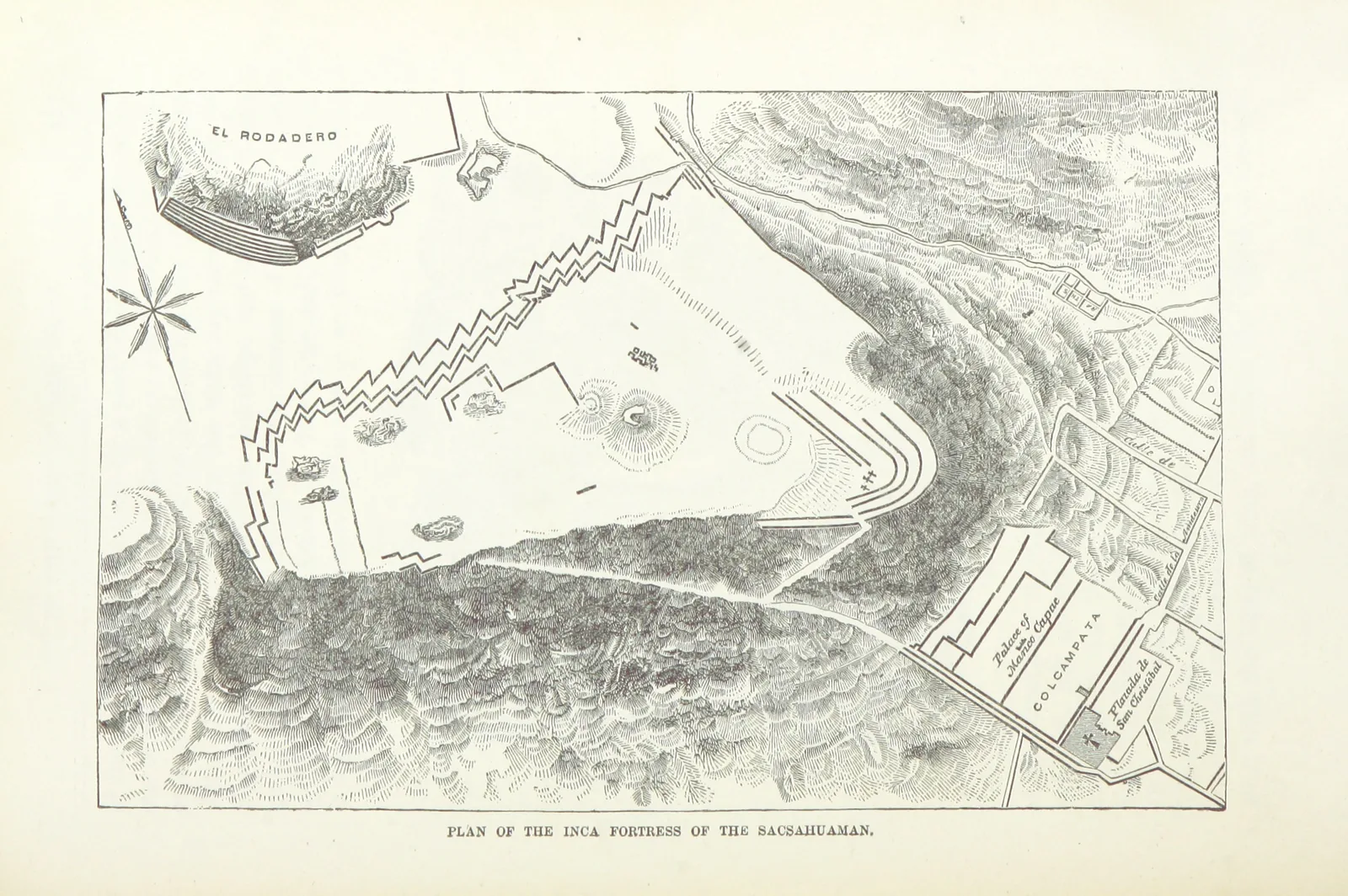
Until then the most detailed record of how Sacsayhuamán was built is still inside it. Somewhere behind the five centimetres a Berkeley architect could reach, the warped face of a limestone block heavier than a loaded truck sits pressed against its neighbour exactly as the last mason left it. Whoever cut that surface could do something nobody has yet been shown to repeat at that size. Where did they learn it?
Images are real photographs and a historical engraving (Squier, 1877), credited and licensed in each caption; none is AI-generated, and no labels or overlays were added. The 1877 plan is rotated 90° for reading; it is printed sideways in the book. Videos are further viewing, not sources. Speculation is labelled as such in the text.
One book behind this article: the stonework study.
Affiliate disclosure: some book links go to Amazon. If you buy through them, The Nommo may earn a small commission at no extra cost to you. It never affects which books we list or how we label them. As an Amazon Associate I earn from qualifying purchases.