
Articles · Mesopotamia · Sumerian King List
241,200 Years: What the Sumerian King List Counted
The kings who rule for tens of thousands of years before the flood were added to the Sumerian King List by its own copyists; the oldest copy, from the Third Dynasty of Ur, starts after the flood at Kish. The added section survives in several versions that disagree on kings and totals, from 241,200 to 456,000 years, yet every one checked counts in the same 3,600-year unit. The same tradition says kingship came down from heaven already made, and later texts fill that age with teachers from the sea who give way to human sages after the flood.
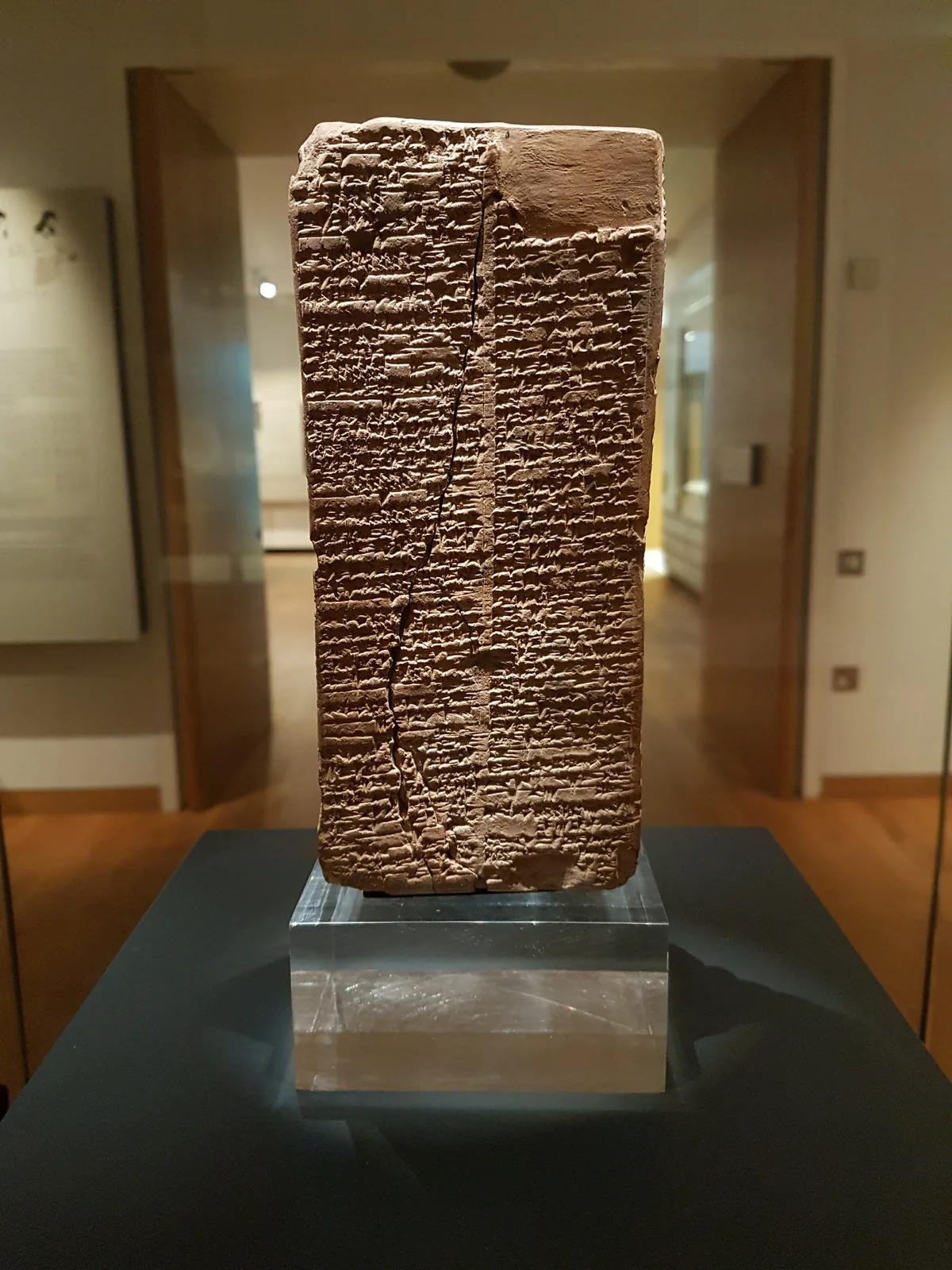
The most famous lines of the Sumerian King List are missing from its oldest copy.
On the clay prism that made the list famous, eight kings rule before a great flood, and their reigns add up to 241,200 years [4]. In the one surviving copy written under the kings of Ur, kingship comes down from heaven and lands straight in the city of Kish. There is no flood in it, and no one before it [1][2].
The pre-flood kings, the part most often quoted, were added by the list’s own copyists. That sounds like the end of the story. It is closer to the start.
Line up the ancient versions of those added kings that still carry numbers, and a pattern shows through the disagreement. The copies differ on names, on cities and on totals. They do not differ on the unit. Every one we checked counts the age before the flood in blocks of 3,600 years.
A Prism in Oxford
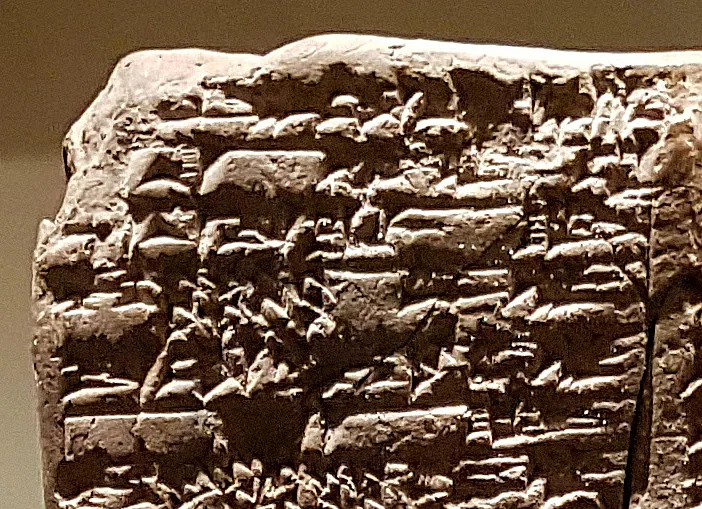
The best-known copy sits in the Ashmolean Museum in Oxford. It is a four-sided clay prism, about 20 by 9 centimetres, with two columns of cuneiform on each side [3]. The museum calls it the most extensive and most complete copy of the list to survive [3]. It was probably written at Larsa, in southern Iraq, around 1800 BC [3].
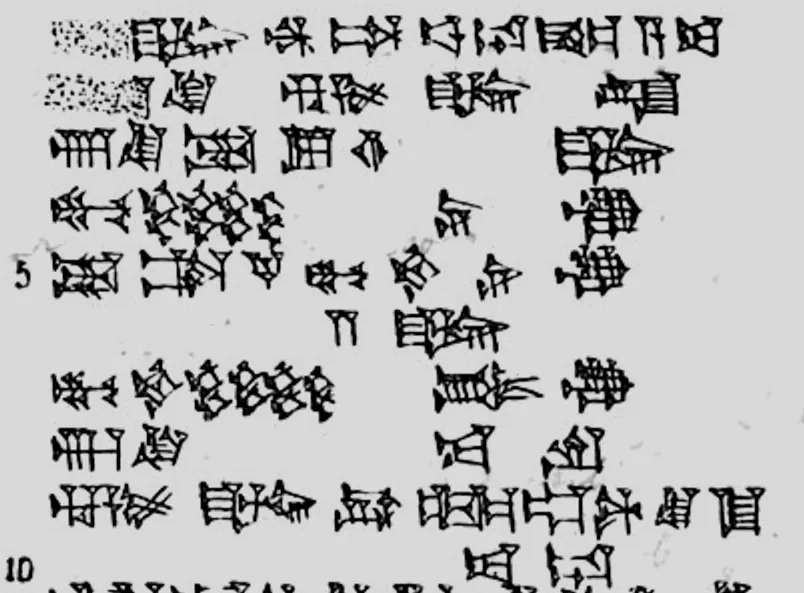
Scholars call it WB 444, after Herbert Weld-Blundell, who presented it to the museum in 1923 [3][12]. Stephen Langdon published the text the same year [6][12].
The Ashmolean’s own heading for the object is blunt: “Ancient political spin.” [3] The museum’s summary says the list “is not history as we would understand it, but a combination of myth, legend and historical information.” [3]
The spin is easy to see once you know the rule the list follows. Kingship is a single thing, and only one city can hold it at a time [3]. The standard formula reads like a relay: “The city A was smitten with weapons; its kingship was carried to the city B.” [5]
The prism ends with Sin-magir of Isin, who reigned around 1827 to 1817 BC [3]. By drawing an unbroken line of kingship down to its own day, the museum notes, Isin cast its rulers as the rightful heirs of every great kingdom before them [3].
Thorkild Jacobsen, whose 1939 study of the list is still the standard starting point, traced the original composition further back. He placed it around the time of Utu-hegal of Uruk, the king who drove out the Gutian invaders [5]. Utu-hegal’s own inscription shares the list’s idea of one kingship that can be carried off and won back [5].
The Copy Without a Flood
Jacobsen also caught the copyists in the act. He did it with grammar.
After the flood, the list moves between cities with the “smitten with weapons” formula. Before the flood it uses a different one. Leaving the first city, Eridu, Jacobsen read the line as the writer speaking in his own voice: “I drop (the topic) Eridu.” [5] Other translators render the verb as “fell” [4].
Jacobsen’s case rested on more than one word. The pre-flood section also uses a plural verb for its totals even when a city had only one king, a habit the older sections do not share [5].
His verdict left little room: “The role of the antediluvian section in the tradition of the King List can thus no longer be doubtful; it is a later addition.” [5]
The manuscripts back him. Several Old Babylonian copies have no room for pre-flood kings, and the closing summaries in some copies count only 11 cities of kingship, a figure that works only if the list starts at Kish [4][5].
Then there is the oldest witness. It is a tablet from the Third Dynasty of Ur, a period the Cuneiform Digital Library Initiative dates to about 2100 to 2000 BC [13].
Its last lines give the founder Ur-Namma 18 years and then wish long life on “Shulgi, my king” [2]. It opens with kingship descending from heaven, and the first city it names is Kish [2][4]. In a 2008 article, Jeremiah Peterson notes “the absence of the antediluvian section in the lone Ur III manuscript” of the list [1].
So where did the eight kings come from? Jacobsen found the same tradition living separately.
It survives on a small Oxford tablet, WB 62, that lists only pre-flood kings, and in a Sumerian flood story that names the same five cities in the same order [5][9]. That story opens its age of cities “after the exalted crown and throne of kingship had descended from heaven.” [9] Then, it says, “the divine rites and the exalted powers were perfected, the bricks of the cities were laid in holy places” [9].
Jacobsen traced that tradition to Eridu, the city of the god Enki, which stands first in both the prism and the flood story [5][9].
He also noticed something the later editor’s arrangement hides. The separate source “has no intent whatever to present the dynasties as successive.” [5] Its cities may have been imagined side by side. The grand total of 241,200 years is the work of the copyist who stacked them end to end.
That is the mainstream case, and it is strong. The pre-flood kings are a graft, from a separate tradition, attached to a list that had a political job to do. What the graft carried with it is the interesting part.
Written in Units of 3,600
Mesopotamian scribes counted in sixties. The historians of mathematics at St Andrews put it plainly: “we can be fairly certain that the sexagesimal system originated with the Sumerians.” [7]
Large numbers were built from named units. A Greek writer named Abydenus kept the old names alive. Isaac Cory’s 1832 collection of ancient fragments preserves his line: “a sarus is esteemed to be three thousand six hundred years; a neros six hundred; and a sossus sixty.” [8] The šar, at 3,600, is the one that matters here. Modern editions also write the 600 and the 60 as separate signs [2][6].
Now read the prism’s pre-flood reigns in those units [4].
| King | City | Years on WB 444 | In šar |
|---|---|---|---|
| Alulim | Eridu | 28,800 | 8 |
| Alalgar | Eridu | 36,000 | 10 |
| En-men-lu-ana | Bad-tibira | 43,200 | 12 |
| En-men-gal-ana | Bad-tibira | 28,800 | 8 |
| Dumuzid the shepherd | Bad-tibira | 36,000 | 10 |
| En-sipad-zid-ana | Larak | 28,800 | 8 |
| En-men-dur-ana | Sippar | 21,000 | 5 šar + 5 × 600 |
| Ubara-Tutu | Shuruppak | 18,600 | 5 šar + 1 × 600 |
| Total | 5 cities | 241,200 | 67 šar |
The first six reigns are whole šar. Only the last two kings, in the last two cities before the flood, need the smaller 600-year unit. The eight reigns add exactly to the scribe’s own total [4].
Even the total is written in units.
Langdon read the total line as one šar-gal, a “great šar” of 216,000, plus seven šar of 3,600 [6]. That comes to 241,200. He also noted that the same term stands for other values in other texts, so the reading leans on context [6]. The average pre-flood reign on the prism is 30,150 years.
Four Versions, Four Totals
The prism is one witness. Others survive, and they do not agree.
WB 62, the small Oxford tablet, has ten kings in six cities, because it slips in two kings of Larsa [5][6]. Jacobsen put the Larsa kings down to “local patriotism in a copyist who wanted to see his own city” among the ancients [5]. Langdon’s table totals WB 62 at 456,000 years, with Alulim alone ruling 67,200 [6].
One WB 62 king may not be a king at all. Jacobsen, following Benno Landsberger, read his name as the city of Shuruppak, mistaken for a man [5]. The phrase “Ziusudra, the man from Shuruppak” was misread as “the son of Shuruppak” [5]. A place became a ruler with 28,800 years on the throne [6].
The names travelled too. Ubara-Tutu, the prism’s last king before the flood, turns up in the eleventh tablet of the Gilgamesh epic as it was copied at Nineveh [5].
A fragment of Assyrian date in the British Museum, K 11624, gives “Five separate cities, 9 kings” [5]. A small fragment in Philadelphia, N 3514, published by Peterson, gives two kings of Shuruppak 36,000 and 43,200 years, and an overall total of 360,000 [1].
Berossus, a priest of Belus at Babylon who lived in the age of Alexander, gave ten kings before the deluge [8]. His work survives only in excerpts by later writers, collected by Cory: “an hundred and twenty sari, or four hundred and thirty-two thousand years” [8]. His first king, Alorus, rules from Babylon, not Eridu [6][8]. Each tradition kept pulling the beginning toward its own city.
| Version | Kings | Pre-flood total | In šar |
|---|---|---|---|
| WB 444 (prism, c. 1800 BC) | 8 | 241,200 | 67 |
| WB 62 (pre-flood tablet) | 10 | 456,000 | 126⅔ |
| N 3514 (Philadelphia fragment) | not preserved | 360,000 | 100 |
| Berossus (Greek, via Cory) | 10 | 432,000 | 120 |
The totals swing by nearly a factor of two. Yet every individual pre-flood reign we could check across these four versions is a whole number of 600-year units, and most are whole šar [1][4][6][8]. This tally is ours, made from the published figures.
Langdon, who edited both Oxford tablets, gave up on a system: “it is totally impossible to reconstruct the ante-diluvian figures into any intelligible scheme.” [6] He was right about the figures. The unit is the part that held.
The Scribe Who Gave Himself Away
Copying errors are real, and the list has plenty. This is the mainstream’s best evidence, so it deserves full weight.
In the first dynasty of Kish, one line on the prism reads, in Jacobsen’s translation, “Destroyed! To the heavenly Nidaba is it clear!” [5] It is not a king. It is a copyist admitting that his original was damaged, and trusting the goddess of writing to know what it said [5].
Utu-hegal, the king who freed Sumer from the Gutians, rules 427 years on the prism [4]. Another manuscript gives him 7 years, 6 months and 15 days [4]. Jacobsen judged the prism’s number, written as seven sixties plus seven, is “clearly a corrupt form” of the shorter reign [5].
The first king after the flood gets 1,200 years on the prism [4]. In the Ur III copy he gets three 600s and six 60s, or 2,160 [2]. Numbers drifted as they were copied, and sometimes they ballooned.
So big numbers alone settle nothing. The drift, though, is untidy. It produces 427, or a stray 2,160. The pre-flood numbers are tidy in every version we checked, built from the same large blocks even when the counts change.
What Came Down From Heaven
The list never says kingship was invented. It says kingship arrived.
The prism opens: “After the kingship descended from heaven, the kingship was in Eridug.” [4] After the flood it says the same thing again: “After the flood had swept over, and the kingship had descended from heaven, the kingship was in Kic [Kish].” [4] Kingship comes down twice, once at the start and once at the reset.
The flood story is more concrete. It is the “exalted crown and throne of kingship” that descend [9]. Jacobsen pointed to an Old Babylonian version of the Etana epic, whose opening says “A king they had not appointed for all the . . . . people” while the insignia of kingship still rested in heaven before the sky god An [5].
Etana himself appears on the list as “the shepherd, who ascended to heaven” [4]. One story sends the crown down. Another sends a king up.
The mainstream reading is clear and reasonable. Divine origin is what makes a throne legitimate, and a list written as political spin would lean on it [3]. The texts themselves, though, describe kingship as an object, finished somewhere else and handed down.
Falling to Human Scale
After the flood, the numbers come down hard.
The first Kish dynasty has 23 kings and 24,510 years on the prism, plus 3 months and 3½ days [4]. That is about 1,066 years a reign, roughly 28 times shorter than before the flood. The months and half-days are new. The Ur III copy already carries 3 months and 3½ days in one Kish king’s line [2].
Kish’s early kings have strange names. Jacobsen translated several as animals: “dog,” “lamb,” “scorpion” and “male gazelle” [5].
Then kingship passes to Uruk. Its first king, a son of the sun god Utu, ruled 324 years and “entered the sea and disappeared” [4]. Enmerkar follows with 420 years, Lugalbanda with 1,200, Dumuzid the fisherman with 100 [4].
Then Gilgamesh, “whose father was a phantom (?),” with 126 years [4]. His son, Ur-Nungal, rules 30 [4]. The last seven kings of the dynasty average 20 years each [4].
Somewhere between Gilgamesh and his son, the list reaches human scale.
The mainstream has a good explanation for the slope. Jacobsen’s study treats the list as braided together from the local traditions of Kish, Uruk, Ur and other cities, each with its own legends and its own early heroes [5]. The decline is not smooth. A later Kish dynasty runs 8 kings for 3,195 years [4].
Still, the overall pattern is plain on the prism. Before the flood, reigns are measured in šar. After it, in centuries, then in decades.
Teachers From the Sea
The King List itself says nothing about teachers. Later tradition filled that gap, and it filled it the same way twice.
Berossus described a being named Oannes that came up from the Erythrean sea, in one excerpt’s telling in the very first year [8]. Its body was a fish’s, with a second head beneath the fish’s head and feet like a man’s [8]. By day it lived among people, and “he gave them an insight into letters and sciences, and arts of every kind.” [8] At night it went back into the sea [8].
Under later pre-flood kings, Berossus’ excerptors record more of these fish-men coming out of the same sea [8]. Then the flood comes in the reign of Xisuthrus, the tenth king. In one excerpt, he is told to deposit all the writings in his possession in the city of the Sun at Sippar before the waters rise [8].
The second witness is cuneiform. On 16 May 165 BC, a scholar named Anu-belshunu wrote out a list in the city of Uruk [10]. It survives in a single copy from the temple called Bit Resh [10]. Sophus Helle’s 2018 study gives the text.
Each pre-flood king has a sage at his side. Under Ayyalu, the sage is Oannes. Under Alalgar, Oannes-duga. The list runs through Dumuzi the shepherd and ends with Enmeduranki, whose sage is Utu-abzu [10].
Helle describes these pre-flood sages as “semi-divine creatures that rose from the sea to lay the foundations of civilization.” [10] After the flood, under Enmerkar, the sage is Nungal-pirigal, and he “is fully human” [10]. He is the one who brings the goddess Ishtar down from the heavens into the Eanna temple at Uruk [10]. Helle points out the symmetry: eight sages before the dividing line, eight human scholars after it [10].
These are late texts, and they have motives. A 2008 study by Alan Lenzi, in its abstract, calls the Uruk list “an attempt by scholars to gain support for themselves and their novel cultic agenda.” [11] Langdon noted that “the original sources make no mention of Oannes,” and he identified the fish-man with Ea, the Babylonian name for Enki, god of Eridu [6]. “Sumerian tradition traced the origins of civilisation to Eridu and its patron deity,” he wrote [6].
Grant all of that. The pattern still stands in the texts. Both late traditions place their teachers from the water in the age measured in šar [8][10]. In the Uruk list, the first teacher after the flood is a man [10].
What the Units Were Counting
Here is what the documents show. Copyists grafted an age before the flood onto a political king list.
Every version we checked counts that age in the same 3,600-year blocks, though no two agree on the total. The texts say kingship came down from heaven already made, and later scribes filled the same age with teachers from the sea. After the flood, the reigns fall toward human size, and in the Uruk list so do the teachers.
The rest is interpretation, and it should be read as that.
The mainstream reading is that the units are a scale of distance. Use the largest round numbers you own to say “very long ago, when gods were near,” and drop to real numbers when memory takes over. That reading explains a great deal, and nothing here refutes it.
Another reading, offered as speculation, starts from what the copyists kept rather than what they changed. They changed kings, cities and totals freely. They kept the unit, the flood line, the heaven-sent kingship of the older texts and, in later centuries, the teachers from the water. A tradition this careless with names and this careful with structure may be remembering an order of things, not a roster. On that reading, it recalls a time when kingship and the crafts were delivered rather than built, and when the measure of a reign was not a human one.
Neither reading can be settled from these tablets. A copy of the pre-flood list as old as the Ur III tablet would test both. None of the sources consulted here reports one.
The prism is still in Oxford [3]. Its total line reads, in Langdon’s rendering, one great šar and seven more [6]. The copyists who carried this age from tablet to tablet disagreed about almost everything. In every version we checked, they kept the unit.
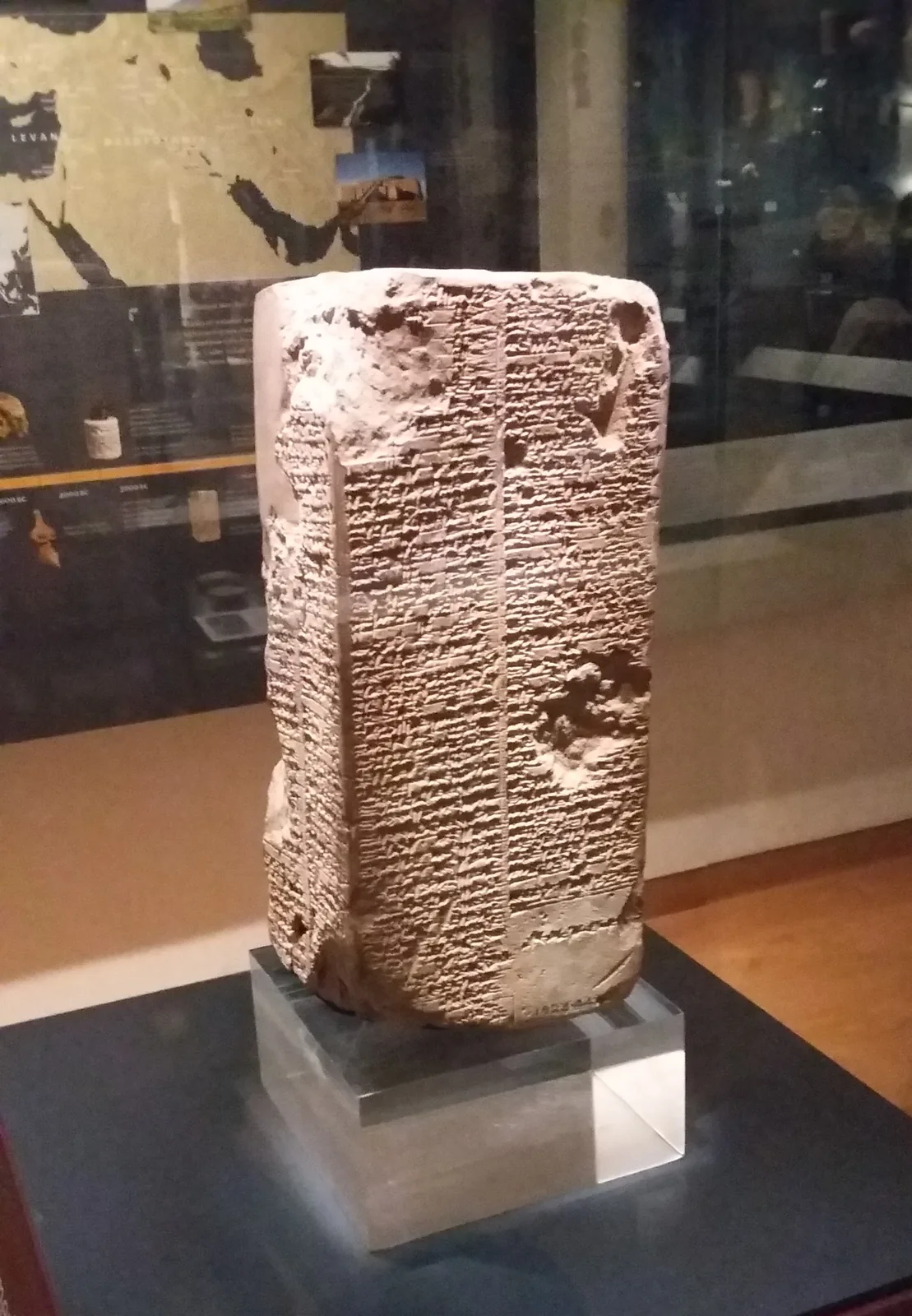
What it was counting is still an open question.
Sources
- Peterson, Jeremiah. "A New Sumerian Fragment Preserving an Account of the Mesopotamian Antediluvian Dynasties." Aula Orientalis 26 (2008): 257–262. https://aulaorientalis.org/AuOr%20escaneado/AuOr%2026-2008/AuOr%2026-2008-2/2-4-Peterson-Antediluvian-Fragment-def.pdf
- CDLI P283804 (Ur III manuscript of the Sumerian King List), transliteration. https://cdli.mpiwg-berlin.mpg.de/artifacts/283804
- Ashmolean Museum, "The Sumerian King List." https://www.ashmolean.org/sumerian-king-list
- ETCSL 2.1.1, "The Sumerian king list: translation." Numbers from ms. WB unless noted. https://etcsl.orinst.ox.ac.uk/section2/tr211.htm
- Jacobsen, Thorkild. The Sumerian King List. Assyriological Studies 11. Oriental Institute, 1939. https://isac.uchicago.edu/research/publications/as/as-11-sumerian-king-list
- Langdon, Stephen. Historical Inscriptions, Containing Principally the Chronological Prism W-B 444. Oxford Editions of Cuneiform Texts 2. Oxford, 1923. https://archive.org/details/historical-inscriptions-containing-principally-the-chronological-prism-w-b.-444
- O'Connor, J. J., and E. F. Robertson. "Babylonian numerals." MacTutor History of Mathematics, University of St Andrews. https://mathshistory.st-andrews.ac.uk/HistTopics/Babylonian_numerals/
- Cory, Isaac Preston. Ancient Fragments. London: Pickering, 1832 (Berossus, Abydenus, Apollodorus, Alexander Polyhistor). https://archive.org/details/ancientfragments00coryrich
- ETCSL 1.7.4, "The flood story." https://etcsl.orinst.ox.ac.uk/section1/tr174.htm
- Helle, Sophus. "The Role of Authors in the 'Uruk List of Kings and Sages': Canonization and Cultural Contact." Journal of Near Eastern Studies 77, no. 2 (2018): 219–234. https://doi.org/10.1086/699166
- Lenzi, Alan. "The Uruk List of Kings and Sages and Late Mesopotamian Scholarship." Journal of Ancient Near Eastern Religions 8 (2008): 137–169. Abstract only. https://brill.com/view/journals/jane/8/2/article-p137_1.xml
- CDLI P384786 (Ashm 1923-0444, W-B 444), catalogue record. https://cdli.mpiwg-berlin.mpg.de/artifacts/384786
- CDLI, "Periods." https://cdli.mpiwg-berlin.mpg.de/periods
Images are real photographs and a 1923 public-domain hand copy (Langdon), credited and licensed in each caption; none is AI-generated, and no labels or overlays were added. Speculation in the closing section is labelled as such in the text.